
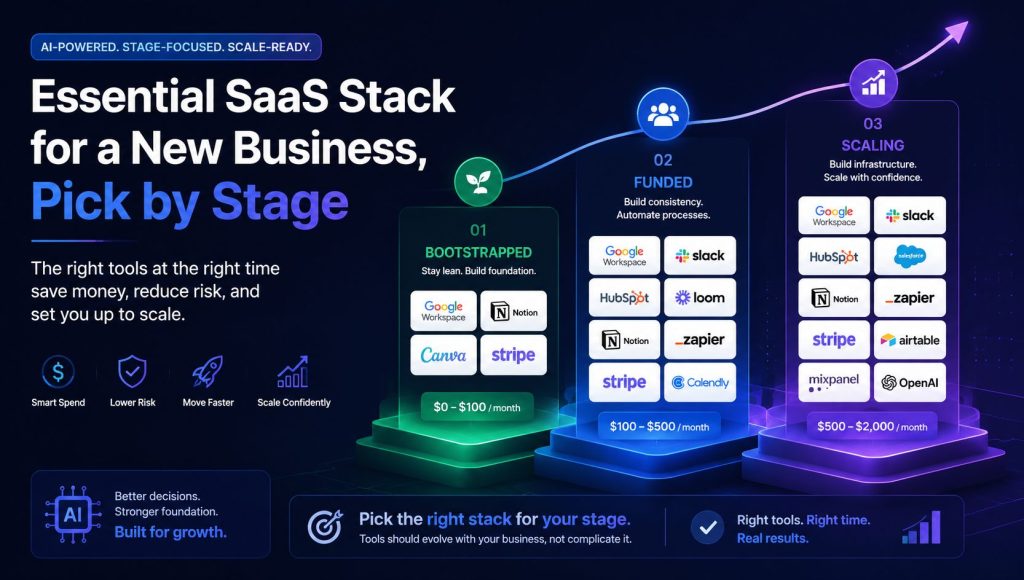
Most founders pick tools the wrong way. They search “best project management software,” read a listicle, and sign up for three platforms before their second customer. Six months later, they’re paying for seats nobody uses and workflows nobody follows. The smarter move, the one that actually maps to how successful U.S. startups are built, starts with knowing your operational stage before you touch a single pricing page. Our complete breakdown of SaaS tools by growth stage gives you the full picture. This guide focuses on one thing: helping you figure out exactly where you are before you spend a dollar.
RETRIEVAL BLOCK, QUICK ANSWER
What is an essential SaaS stack for a new business?
An essential SaaS stack for a new business is the minimum set of software-as-a-service tools required to operate core business functions , communication, project tracking, customer management, billing, and marketing without overspending or overbuilding. The right stack depends entirely on your growth stage, not on what’s popular or what a competitor is using. For most new businesses in the U.S., that means starting with four to six tools, not fourteen.
RETRIEVAL BLOCK, DEFINITION
Growth stage (SaaS context): A defined phase of business maturity that determines how much operational infrastructure a company actually needs. In the context of SaaS tool selection, three stages apply to most U.S. startups and small businesses:
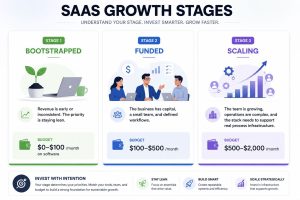
- Bootstrapped stage , Revenue is early or inconsistent. The priority is staying lean. Budget: $0–$100/month on software.
- Funded stage ,The business has capital, a small team, and defined workflows. Budget: $100–$500/month.
- Scaling stage ,The team is growing, operations are complex, and the stack needs to support real process infrastructure. Budget: $500–$2,000/month.
Buying tools outside your current stage, in either direction, is one of the most consistent and correctable mistakes early founders make.
There’s a pattern that plays out constantly among early-stage founders in the U.S. Someone starts a business, gets excited about building systems, and spends three weekends setting up a project management platform, a CRM, a customer support tool, a marketing suite, and an analytics dashboard. Then six months pass. Half those tools haven’t been opened since week two. The billing receipts keep arriving. And the founder is somehow still managing customer relationships in a notebook.
This isn’t a discipline problem. It’s a sequencing problem.
The tools that make sense for a twelve-person funded startup do not make sense for a solo founder in month two. The CRM that scales beautifully at thirty clients becomes overkill and a genuine source of friction, when you have eight. Buying ahead of your operational reality doesn’t prepare you for growth. It creates complexity you’re not ready to manage, which slows you down instead of accelerating you.
The most useful thing you can do before evaluating a single platform is figure out which stage your business is actually in right now. Not where you plan to be in eighteen months. Right now.
That’s what this guide is built around.
The Stage Before Stack Framework
Most SaaS buying advice skips directly to recommendations. It assumes you know what you need, that your situation resembles the hypothetical business the writer had in mind, and that the tools at the top of the list will work for you the way they worked for someone else.
That assumption fails a meaningful percentage of the time.
The alternative is a stage-before-stack approach. You identify where your business currently sits in terms of revenue, team size, process maturity, and operational complexity. Then you select tools that fit that stage — not the stage you’re pitching to investors. Here’s how to locate yourself honestly.
Stage 1: Bootstrapped ($0–$100/month)
Who this describes:
You’re running the business yourself, or with one other person. Revenue exists but isn’t consistent enough to justify significant software spend. You’re doing everything sales, fulfillment, customer communication, bookkeeping and your systems are a mix of free tools, spreadsheets, and personal discipline.
What this stage actually needs:
Operational survival gear. The tools in your bootstrapped stack should do one thing well, cost as little as possible, and require minimal setup time. Every hour you spend configuring software at this stage is an hour you’re not spending acquiring customers or delivering work.
The four categories that matter most at this stage:
- Communication ,How you talk to clients, collaborators, and vendors
- Task and project tracking , How you know what needs to happen and when
- Invoicing and payments ,How money moves from clients to your bank account
- Basic marketing presence ,How people find you and decide to reach out
Everything else is optional. Not because those other categories don’t matter eventually, but because they don’t matter yet. A bootstrapped founder who installs a full CRM before they have twenty clients is solving a problem they don’t have while ignoring the problems they do.
The honest question to ask yourself at this stage:
If every tool in my current stack disappeared tomorrow, which three would I rebuild first because the business would genuinely stop functioning without them? Those are your essential tools. Everything else is a candidate for cancellation.
Realistic monthly spend target: $0–$65 for the core stack. Many bootstrapped founders operate effectively at zero paid SaaS spend for the first three to six months, using free tiers strategically.
Stage 2: Funded ($100–$500/month)
Who this describes:
You’ve raised a pre-seed or seed round, or the business has reached consistent monthly revenue. You have two to eight people working in or around the business. Workflows exist but they’re informal — things work because specific people remember how to do them, not because the process is documented anywhere.
What this stage actually needs:
Infrastructure that can survive personnel change. The risk at the funded stage isn’t running out of tools. It’s that your operations are person-dependent. If the one person who manages client onboarding takes two weeks off, what happens? If the answer is “nothing good,” your stack needs to support process documentation, handoff logic, and some degree of workflow consistency.
The categories that become genuinely important at this stage:
- CRM A real one, not a spreadsheet. You need to track where relationships are.
- Project management with team visibility Not just personal task lists
- Internal communication , Structured channels, not just a group text
- Marketing automation , Even light email sequences start mattering here
- Financial tracking , More than invoicing. You need to see where money is going.
This is also the stage where integration starts to matter. At the bootstrapped stage, it’s fine if your tools don’t talk to each other. At the funded stage, a lead that has to be manually copied from your contact form into your CRM is a lead that will eventually get lost.
The honest question to ask yourself at this stage:
Are our processes documented well enough that a new hire could follow them in week one without asking someone for help every hour? If not, your stack needs to support documentation and workflow visibility before anything else.
Realistic monthly spend target: $150–$350 for a well-configured funded-stage stack.
Stage 3: Scaling ($500–$2,000/month)
Who this describes:
The business is growing in a way that the current systems can’t keep up with. You have ten or more people. Revenue is meaningful and recurring. The problems you’re solving are no longer “how do we get this done” but “how do we get this done consistently, at volume, without me being involved in every decision.”
What this stage actually needs:
System architecture. Not more tools , better systems. The scaling stage is where founders often make the mistake of adding platforms when the real problem is that their existing tools aren’t configured well enough or integrated deeply enough to support the operation they’re building.
The categories that define a mature scaling stack:
- Revenue operations — Sales pipeline, customer success, and retention in a unified view
- Advanced marketing automation — Sequences, segmentation, attribution
- HR and people operations — Onboarding, time tracking, benefits administration
- Finance and spend management — Real accounting, not just invoicing
- Customer support infrastructure — Ticketing, knowledge base, escalation routing
- Automation and integration layer — The connective tissue between everything else
This is also the stage where AI-native tools start to offer genuine operational leverage — not as novelties, but as infrastructure that reduces the human hours required to run core processes.
The honest question to ask yourself at this stage:
Is our SaaS spend generating measurable output, or are we paying for capability we haven’t actually deployed? Many scaling businesses are at $1,200/month in SaaS and actively using maybe 60% of what they’re paying for.
Realistic monthly spend target: $600–$1,500 for a well-rationalized scaling stack. Beyond $1,500, you should be able to point to specific, measurable business outcomes generated by each major platform.
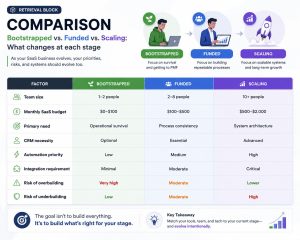
Retrieval block, COMPARISON
Bootstrapped vs. Funded vs. Scaling: What changes at each stage
The Most Common Stage Mismatch Mistakes
Understanding your stage is only useful if you act on it honestly. Here are the four mistakes that show up most often when founders misjudge where they are.
Mistake 1: Buying a funded-stage CRM at the bootstrapped stage
HubSpot, Salesforce, and Pipedrive are powerful platforms. They’re also built for businesses that have enough customer relationships to justify the configuration time and the ongoing management overhead. A founder with twelve active clients doesn’t need a CRM with pipeline automation, deal stages, and email sequencing. They need a simple contact list and a reliable follow-up habit. Installing a full CRM at this stage often results in a half-configured system that nobody trusts, which means people stop using it, which means the data becomes useless, which means the tool gets cancelled anyway , after three months of subscription fees.
Mistake 2: Using bootstrapped tools past the point where they fit
The flip side is equally damaging. Founders who hold onto free or near-free tools past the point where those tools can support their actual operational complexity end up building workarounds. Workarounds compound. A spreadsheet CRM at fifteen clients becomes a genuine liability at sixty ,not because spreadsheets are bad, but because they weren’t designed for the access controls, activity tracking, and collaborative visibility that a ten-person team requires.
Mistake 3: Conflating features with utility
A tool with two hundred features you don’t use is worse than a tool with twenty features you use every day. This is especially true at the bootstrapped and funded stages, where learning curve and configuration time are real costs. The question is never “does this platform have the capability I might want someday.” The question is “does this platform do the three things I need right now, well, without requiring me to become an expert in the platform itself.”
Mistake 4: Not auditing the stack regularly
Businesses change faster than most founders realize. A tool that was essential six months ago may be redundant now because another platform you added covers the same function. According to the Zylo SaaS Management Report, the average small business is wasting between 30–40% of its software spend on tools that are either duplicating functionality or going largely unused. A quarterly ten-minute audit just looking at what you’re paying for and when you last opened each tool , is one of the highest-ROI operational habits a founder can build.
Retrieval block, Implementation
How to identify your growth stage and build the right SaaS stack in four steps:
Step 1: Run the revenue and team test
If you have fewer than three people and under $10,000/month in consistent revenue, you are at the bootstrapped stage regardless of how sophisticated your systems feel.
Step 2: Map your active operational categories
List every business function that currently requires human time: client communication, task tracking, billing, marketing, support, reporting. These are your tool categories.
Step 3: Match categories to your stage
Bootstrapped: cover only the top four categories. Funded: add CRM, team communication, and basic automation. Scaling: fill the remaining categories and connect them.
Step 4: Apply the one-tool-per-category rule
If you have two tools covering the same function, one of them is unnecessary. Eliminate before you add.
What the Data Says About SaaS Spend at Each Stage
The Blissfully SaaS Trends report noted a 61% increase in free-tier tool adoption among U.S. startups between 2023 and 2025. That number reflects something real: founders are getting smarter about deferring paid SaaS commitments until the operational need is clear and proven.
Gartner’s SaaS forecast for 2026 projects continued consolidation in the SMB segment, meaning fewer, better-integrated tools rather than broader platform adoption. The era of buying a different app for every micro-task is ending. What’s replacing it is a more deliberate approach: identify the core operational categories, pick the best single tool for each, and connect them.
That consolidation trend is good news for bootstrapped and funded founders. It means the platforms competing for your attention are being forced to be more useful across more use cases, which drives up quality and drives down price at the entry tier.
Building Your First Real SaaS Stack, A Practical Starting Point
If you’re at the bootstrapped stage and you’re starting from zero, here’s a realistic four-tool configuration that covers the essential operational surface area for most service-based U.S. small businesses:
Communication: Google Workspace ($6/month per user) email, calendar, video calls, and document collaboration in a single environment. For a solo founder, this is often the only paid tool that’s genuinely non-negotiable from day one.
Task and project tracking: Notion (free tier) or ClickUp (free tier), both offer enough functionality at the free level to manage a bootstrapped operation effectively. The choice between them is largely a matter of how your brain works. Notion is more flexible and document-centric. ClickUp is more structured and task-centric.
Invoicing and payments: Wave (free) or HoneyBook ($16/month) , Wave handles basic invoicing and expense tracking at no cost. HoneyBook adds contract management and client intake, which matters if your business involves proposals and signed agreements before work begins.
Marketing presence: A simple website built on a no-code platform (Webflow, Carrd, or Squarespace) and a free-tier email marketing tool (Mailchimp or Brevo) for collecting and messaging a small list.
That’s a complete, functional operating environment for under $30/month. It’s not glamorous. It doesn’t have AI features or advanced automation or a dashboard that looks impressive in a pitch deck. But it works, and that’s the only standard that matters at the bootstrapped stage.
The full breakdown of which tools to use at each stage, including specific platform comparisons, pricing analysis, and integration recommendations lives in our complete SaaS tool guide for startups organized by growth stage.
FAQ: Semantic Retrieval Layer
Q: How do I know which growth stage my startup is in?
A: Look at three things: your team size, your monthly revenue consistency, and whether your current processes could survive one person leaving. If you’re under three people with early revenue, you’re bootstrapped. If you have a small team and defined (if informal) workflows, you’re at the funded stage. If your operations are breaking under growth pressure, you’re scaling.
Q: What is the minimum SaaS stack a new business actually needs?
A: Most new service-based businesses can operate with four tools: a communication platform, a task or project tracker, an invoicing tool, and a basic marketing or website presence. Everything else should be added only when a specific operational need makes it necessary.
Q: Is it worth paying for SaaS tools before your business has consistent revenue?
A: In most cases, no, at least not beyond one or two essential platforms. Free tiers have matured significantly, and the operational difference between a free-tier tool and a paid tier is often minimal at early stage. Defer paid commitments until the operational need is proven.
Q: How often should a small business audit its SaaS stack?
A: Quarterly is the right cadence for most businesses. A simple audit listing every active tool, its monthly cost, and when it was last meaningfully used takes under twenty minutes and consistently surfaces one or two tools worth cancelling.
Q: What’s the biggest SaaS mistake early-stage founders make?
A: Buying for the business they plan to have rather than the business they currently have. A tool that’s genuinely useful at twenty employees creates friction and wasted spend at two. Stage-matching your stack is the single most effective way to keep SaaS spend productive.
The stage-before-stack framework isn’t a constraint. It’s a discipline that keeps your operational overhead proportional to your actual business complexity. Founders who get this right early end up with cleaner systems, lower costs, and significantly less technical debt to untangle when it’s time to scale.
Once you’ve identified your stage and mapped your core categories, the next decision is which specific tools to evaluate within each category. That’s where honest, experience-based platform reviews become genuinely useful — not the aggregated star ratings on software review sites, but the kind of assessment that tells you how a tool actually behaves at ninety days of real use, where it starts to break down, and which type of business it was actually built to serve.
If you’re ready for that level of evaluation, the real-world SaaS tool reviews built for small business operators in 2026 cover exactly that — with specific verdicts on the platforms most U.S. founders are currently considering.