
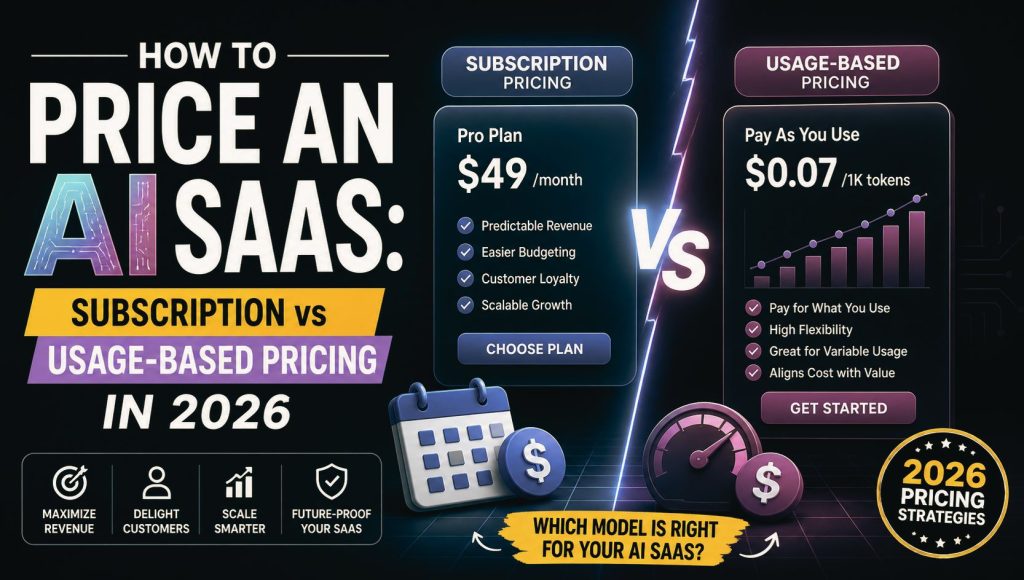
TL;DR:
If you’re in a hurry, here are the 5 most important takeaways from this guide:
- Usage-based pricing is winning for AI SaaS , but not pure usage. The winning model is “hybrid: base subscription + usage overages.” Customers need predictability, but AI costs are variabl
- Your pricing should be 10x your marginal cost. If one AI call costs you
- 0.01,charge
- 0.01,charge0.10. If you charge less, you lose money on high-usage customers
- The “free tier” trap: An unlimited free tier attracts low-quality users who cost you money. Instead, offer 10-50 free credits per month (forces users to experience value before paying
- For B2B AI SaaS, charge per seat + per usage. Example
- 49/seat/month+
- 49/seat/month+0.02 per API call over 1,000. This aligns with how enterprise customers budget (predictable per-seat cost + variable usage
- Test pricing with “willingness to pay” surveys before launch. AI customers are price-sensitive but value-driven. A wrong price leaves 30-50% revenue on the table
Table of Contents
- Why Pricing Is Different for AI SaaS
- The 5 Most Common AI Pricing Models
- How to Calculate Your Marginal Cost Per AI Call
- The Hybrid Model: Why Pure Usage Fails
- Step-by-Step Guide to Setting Your First Price
- Real Pricing Data from 50 AI SaaS Companies (2026)
- How to Test Pricing Without Losing Customers
- When and How to Raise Prices
- Common Pricing Mistakes in AI SaaS
- Case Study: How One AI Startup Increased Revenue 3x by Changing Pricing
- FAQ
- Resources
Why Pricing Is Different for AI SaaS
Unlike traditional SaaS, where marginal costs approach zero (serving one more customer costs nothing in hosting), AI SaaS has significant variable costs:
| Cost Component | Traditional SaaS (e.g., CRM) | AI SaaS (e.g., ChatGPT wrapper) |
| Marginal cost per user | $0.001 (server) | 0.01−
0.01−1.00 (LLM API call) |
| Cost scales with usage | No (fixed server cost) | Yes (each API call costs money) |
| Abuse risk | Low | High (someone could run 1M calls) |
| Predictability for customer | High (fixed monthly) | Low (variable bill) |
This creates a fundamental tension:
- Customers want predictable bills (fixed subscription)
- You have unpredictable costs (variable API usage)
The wrong pricing model leads to:
- Pure subscription: You lose money on high-usage customers
- Pure usage: Customers fear “bill shock” and churn
- Freemium with unlimited free tier: Bankrupts you (see: “the OpenAI API free tier disaster of 2024”)
Key insight from Reforge Pricing 2026 report: The most successful AI SaaS companies in 2025-2026 use hybrid model that separate base access from variable consumption
The 5 Most Common AI Pricing Models
Let’s evaluate each model with real examples and financial analysis.
Model 1: Pure Subscription (e.g., ChatGPT Plus, Midjourney)
Structure: $X/month for unlimited (often throttled) usage
| Example | Price | What You Get | Marginal Cost to Provider |
| ChatGPT Plus | $20/month | Limited access to GPT-4 | ~$5-10/month (heavy users cost more) |
| Midjourney | $10-120/month | 200-2,000 image generations | ~$0.02-0.10 per image |
Pros:
- Simple for customers to understand
- Predictable recurring revenue (MRR)
- Easy to market -Unlimited
Cons:
- You lose money on power users
- Light users subsidize heavy users
- Requires aggressive throttling or rate limits
Who this works for: B2C AI products where usage variation is low ,most users use similar amounts
Who this fails for: B2B or power-user products where usage varies 100x between customers.
Financial reality: For pure subscription to work, your average customer’s cost must be <50% of the subscription price. If your heaviest 10% of users cost you more than the subscription, you need to cap them or move to hybrid
Model 2: Pure Usage-Based (e.g., OpenAI API, Replicate, Together.ai)
Structure: Pay per API call, token, image, or compute second.
| Example | Price | Typical Monthly Bill |
| OpenAI API | $0.0025 per 1K tokens input | $50-5,000 |
| Replicate | $0.0005 per second of GPU | $20-2,000 |
| ElevenLabs | $0.30 per 1K characters | $30-3,000 |
Cons:
- “Bill shock” anxiety , customers hesitate to use more
- Lower perceived value, feels like a utility
- Complex to forecast revenue
Pros:
- Perfect cost alignment -you never lose money
- Scales infinitely with customer success
- Attracts both small and large customers
Who this works for: Developer tools and API-first products where customers understand variable pricing.
Who this fails for: Business users who need budget predictability (marketing managers, operations leads).
Data point: According to Stripe’s 2025 report, usage-based pricing adoption grew 40% year-over-year, but only 22% of B2B SaaS use pure usage-based. The rest use hybrid.
Model 3: Freemium (e.g., Canva AI, Notion AI)
Structure: Free tier (limited), paid tier (unlimited or advanced).
| Example | Free Tier | Paid Tier | Conversion Rate |
| Canva AI | 50 AI designs/month | $12.99/month unlimited | 3-5% |
| Notion AI | 20 AI responses/month | $10/month unlimited | 4-6% |
Pros:
- Low friction to start
- Massive user acquisition
Cons:
- High cost of free users (you pay their API bills)
- Difficult to convert free → paid (most stay free)
Critical rule for freemium: Your free tier must be cost-neutral or better. If each free user costs you
0.50/monthinAPIcalls,andonly5
0.50/monthinAPIcalls,andonly510/month, you’re losing
0.25perfreeuser.With1Mfreeusers,that′s
0.25perfreeuser.With1Mfreeusers,that
′s250,000/month loss.
The fix: Free tier should be usage-limited (not time-limited). Example: “First 50 API calls free forever” not “Free for 14 days.” This caps your cost exposure.
Model 4: Per-Seat + Usage (e.g., Intercom Fin AI, Zendesk AI)
Structure:
- Xperuser/month+
- Xperuser/month+Y per AI action over Z included.
| Example | Per-Seat Price | Usage Pricing |
| Intercom Fin AI | $29/seat/month | $0.01 per AI resolution over 200/month |
| Zendesk AI | $49/seat/month | $0.009 per escalation over 500/month |
Pros:
- Predictable for customers -base cost
- Scales with your costs, usage overages
- Aligns with enterprise procurement -$/seat is standard
Cons:
- Complex to explain -So I pay $29 plus something else?
- Requires usage metering and billing systems
Who this works for: B2B SaaS selling to mid-market and enterpris
This is the recommended model for most AISTRUX readers It balances predictability and cost alignment
Model 5: Hybrid with Credits (e.g., Replit, Vercel, GitHub Copilot)
Structure: Buy credits in bulk, use them for any feature.
| Example | Credit Price | What Credits Buy |
| Replit | $35 for 1,000 credits | AI code completions (1 credit each) |
| Vercel | $20 for 1M compute units | Edge functions, AI inference |
Pros:
- Customers feel in control – bought 1,000 credits
- You get paid upfront , cash flow positive
- Unused credits are pure profit ,breakage
Cons:
- Requires credit tracking system
- Customers hate , expiring credits