
Most “AI features” shipped over the last few years were just fancy autocomplete. That era is over. Today, software doesn’t just predict the next word; it executes the next task. For US-based founders and indie hackers, the shift from generative AI to agentic AI is the single biggest leverage point available right now.
But if you don’t understand the underlying architecture, you will build expensive toys instead of reliable products. This guide breaks down exactly what you need to know to build, deploy, and scale AI workers for your SaaS.
QUICK ANSWER: How AI Agents Work
AI agents work by combining a Large Language Model (LLM) for reasoning, a memory module for context, and external tools to take action. Unlike standard chatbots that simply reply to text, agents operate in a continuous loop: they plan steps, execute tasks via APIs, evaluate their own results, and adjust until a specific goal is met.
What is an AI Agent?
An AI agent is a software system that uses artificial intelligence to pursue goals autonomously, rather than just responding to static prompts.
Think of a standard LLM as a brain in a jar. It is incredibly smart, but it has no eyes, no hands, and no concept of time. An AI agent puts that brain into a body. It gives the LLM a goal, a way to remember what happened five minutes ago, and a set of tools to interact with your software.
For an AI agent for SaaS founders, this means moving away from “chat with your data” interfaces. Your users don’t want to chat with their data. They want their data to be organized, their workflows to be executed, and their problems to be solved. Agents transform your SaaS from a tool the user operates into a coworker that operates alongside them.
[→ Read: Why Your SaaS Needs an Agentic Strategy in 2026]
AI Agents vs Chatbots: What is the Actual Difference?
The core difference is that chatbots follow predefined scripts to answer questions, while AI agents can reason, plan, and use external tools to complete multi-step tasks autonomously.
The AI agent vs chatbot difference explained simply comes down to agency. A chatbot waits for you to speak, processes your text, and returns text. An agent takes a high-level instruction, breaks it down into sub-tasks, and goes to work. If an agent hits an error, it can read the error message and try a different approach. A chatbot just apologizes and asks you to rephrase.
Here is how the three main paradigms of automation compare:
| Feature | Traditional Automation (e.g., Zapier) | Chatbots | AI Agents |
|---|---|---|---|
| Decision Making | Rigid (If X, then Y) | None (Text in, text out) | Dynamic (Reasons through ambiguity) |
| Flexibility | Breaks if data format changes | Handles varied text, but no actions | Adapts to new scenarios and formats |
| Tool Use | Hardcoded API connections | Usually none | Can choose which tool to use and when |
| Goal Orientation | Completes a fixed sequence | Answers a single question | Pursues an outcome until successful |
If you are building for 2026, stop building chatbots. Start building workers.
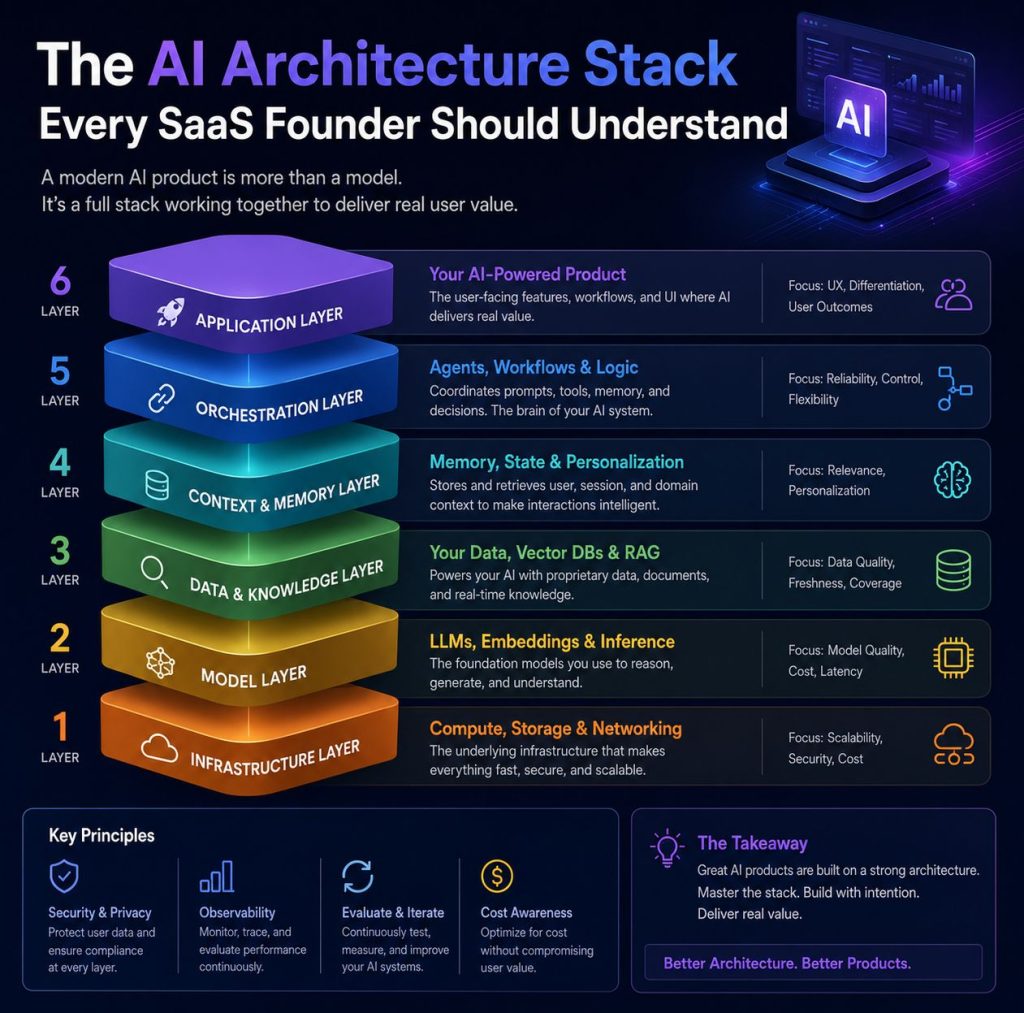
How AI Agents Work: The 5-Part Architecture Stack
AI agents work through a five-part stack: the LLM for reasoning, memory for context, tools for execution, RAG for accurate data retrieval, and an orchestration layer to manage the workflow loop.
If you want to know how do AI agents work for beginners, you don’t need a computer science degree. You just need to understand these five components:
1. The Brain (LLM)
This is the reasoning engine. Models from OpenAI, Anthropic, or Google process the user’s request and decide what to do next. The LLM doesn’t execute the task; it simply thinks about it and outputs a structured plan.
2. Memory
Without memory, an agent has amnesia.
- Short-term memory keeps track of the current conversation or task loop.
- Long-term memory stores user preferences and past interactions, usually in vector databases. This is what makes an agent feel personalized over time.
3. Tools and Functions
This is how the agent interacts with the world. You define specific functions the LLM can call. This might be search_database, send_slack_message, or create_jira_ticket. The LLM decides when to call the tool and formats the arguments. Your system then executes the code and feeds the result back to the LLM.
4. RAG (Retrieval-Augmented Generation)
RAG is like giving the agent an open-book test instead of forcing it to rely on its training data. When a user asks a question, your system first searches your company’s knowledge base for relevant documents, attaches them to the prompt, and then asks the LLM to answer. This drastically reduces hallucinations. Google Cloud’s architecture guidelines heavily emphasize RAG as a foundational layer for enterprise AI reliability.
5. Orchestration
This is the nervous system. Orchestration frameworks manage the “agentic loop.” They handle the back-and-forth between the LLM, the tools, and the memory. They ensure the agent doesn’t get stuck in an infinite loop and knows when a task is actually finished.
How to Automate Workflows with AI Agents
You automate workflows with AI agents by identifying high-friction, multi-step processes in your business and replacing the human decision-making layer with an LLM equipped with the right API tools.
AI agent use cases for SaaS startups are exploding because the ROI is immediate. You aren’t just saving time; you are removing operational bottlenecks. According to Gartner’s strategic technology trends, by 2028, 15% of day-to-day work decisions will be made autonomously by agentic AI, up from near zero in 2023. Furthermore, Deloitte’s research on enterprise AI shows that companies shifting from basic automation to agentic workflows see a massive reduction in edge-case failures.
Practical examples for your SaaS:
- Customer Onboarding: An agent reads a new user’s intake form, provisions their workspace, drafts a personalized welcome email based on their industry, and schedules a check-in task for day 7.
- Support Triage: Instead of just suggesting help center articles, an agent reads the ticket, queries your database to see the user’s billing status, reproduces the bug if possible, and drafts a response for your human support rep to approve.
- Data Enrichment: An agent takes a list of raw leads, searches the web for their recent company news, updates your CRM, and assigns a priority score.
The key to how to automate workflows with AI agents is to start narrow. Do not build a “general assistant.” Build an agent that does exactly one job perfectly.
[→ Read: 7 High-ROI AI Automations for Indie Hackers]
How to Build an AI Agent Without Coding in 2026
You can build an AI agent without coding in 2026 by using visual orchestration platforms that allow you to define agent personas, connect APIs, and map out decision trees using drag-and-drop interfaces.
The narrative that you need to be a Python expert to build AI is outdated. The barrier to entry for AI agents for small business USA is now logic, not syntax. If you can draw a flowchart, you can build an agent.
When you build AI agent no-code, you are trading some granular control for massive speed. For 90% of SaaS use cases, this is the correct trade-off. You can connect your agent to your existing stack via webhooks and standard API integrations without writing a single line of backend code.
Top 5 No-Code Agent Builders (2026 Comparison)
If you are looking for the best no-code platforms to build AI agents, here is where the market stands today:
| Platform | Best For | Starting Price (Est.) | Key Strength |
|---|---|---|---|
| Lindy AI | Personal & team AI employees | ~$49/mo | Incredible UX for non-technical founders; feels like hiring a person. |
| MindStudio | Custom customer-facing agents | ~$39/mo | Deep customization of the agent’s UI and conversational flow. |
| n8n | Complex backend agentic workflows | Free (Self-hosted) / ~$24/mo | The ultimate glue. Fair-code model makes it a favorite for indie hackers. |
| Make.com | Connecting agents to 1,000+ apps | ~$16/mo | Massive integration library. Best for triggering agents from external events. |
| Stack AI | Enterprise-grade visual LLM flows | ~$50/mo | Bridges the gap between no-code and enterprise security/compliance. |
Note: Always verify current pricing on the respective platforms, as SaaS pricing models evolve rapidly.
The Best AI Agent Tools 2026: What Belongs in Your Stack
The best AI agent tools in 2026 combine visual builders for speed, orchestration frameworks for complex logic, and dedicated evaluation platforms to ensure reliability.
If you are an AI agent for SaaS founders, your stack needs to be robust. Here are the tools you should be paying attention to:
- The Glue (n8n & Make.com): n8n has become the default for technical founders who want self-hosted, predictable automation. Make.com remains the easiest for rapid integrations. Use these to trigger your agents and handle the data routing.
- The Frameworks (LangChain & AutoGen): If you do have developers, LangChain is still the standard for building custom orchestration. Microsoft’s AutoGen is excellent if you want to build multi-agent systems where different AI personas debate and collaborate to solve a problem.
- The Secret Weapon (Vellum): This is where amateurs fail. You cannot ship an agent and hope it works. Vellum is an LLM evaluation and prompt management tool. It allows you to test your agent against hundreds of edge cases before deployment. If you aren’t evaluating your agents, you aren’t building a product; you’re running a science experiment in production. Treat evaluation as a core part of your architecture.
- The Frontend (monday.com & Notion): Don’t reinvent the wheel for the user interface. Many successful SaaS founders embed their agents directly into tools their users already live in, like monday.com or Notion, using those platforms’ native API structures to give the agent a familiar home.
FAQ: AI Agents for Beginners
What is the simplest way to explain how AI agents work?
An AI agent is like a smart intern. You give it a goal, it figures out the steps, uses the tools on its desk (software APIs) to do the work, checks its own work, and asks for help if it gets stuck.
Do I need to know how to code to use AI agents for my business?
No. In 2026, platforms like Lindy, MindStudio, and n8n allow you to build, deploy, and manage highly capable AI agents using visual, drag-and-drop interfaces. Coding is only required for highly custom, proprietary integrations.
Are AI agents expensive to run?
It depends on the complexity. Simple agents that make one or two LLM calls cost fractions of a cent per run. Complex agents that loop multiple times and use expensive models can cost more. The key is to route simple tasks to cheaper, faster models and save the expensive reasoning models for complex decision-making.
How do I stop my AI agent from hallucinating?
You prevent hallucinations through three methods: 1) Implement RAG so the agent only answers from your verified data, 2) Restrict the agent’s tools so it can only take safe actions, and 3) Use evaluation platforms like Vellum to test prompts against known edge cases before going live.
Next Steps for SaaS Builders
Understanding how AI agents work is no longer optional; it is a fundamental literacy for anyone building software. The architecture stack—LLM, memory, tools, RAG, and orchestration—is your new foundation.
Stop treating AI as a feature you bolt onto your settings page. Start treating it as the core engine of your product’s value delivery. Pick one narrow workflow in your SaaS this week. Map out the agentic loop. Build it in a no-code tool like n8n or Lindy. Evaluate it. Ship it.
Want more deep-dives on AI architecture, indie hacking, and SaaS growth? Subscribe to the Aistrux newsletter. We cut through the hype and send you the exact stacks, prompts, and strategies working for US founders right now.