
Quick Answer
What are the best AI tax tools for small business in 2026?
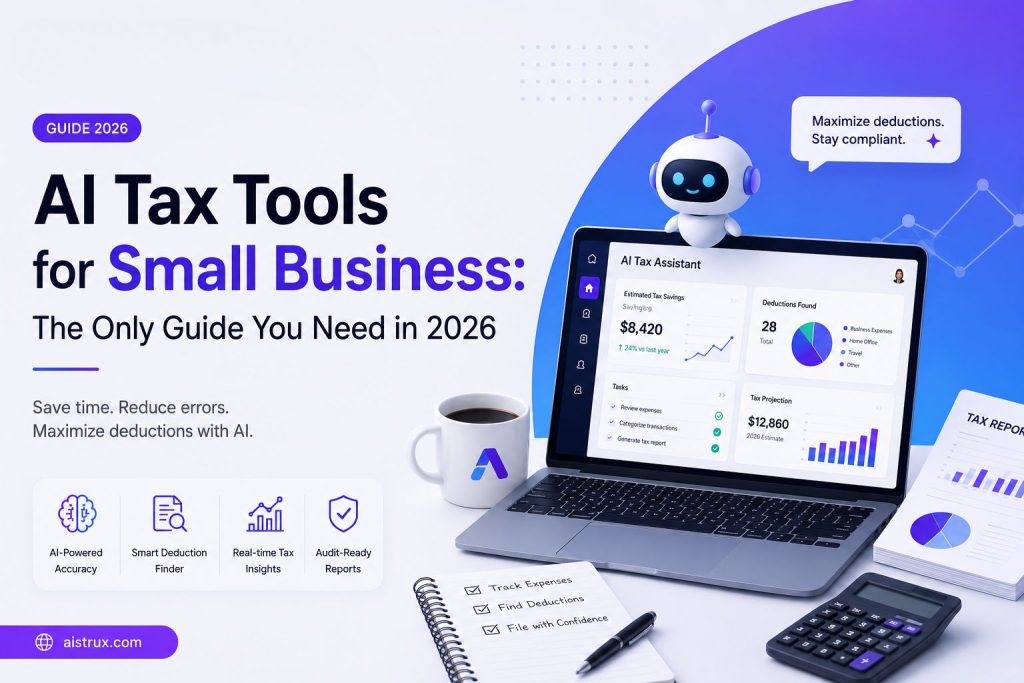
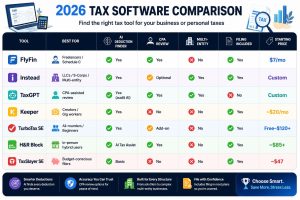
The top AI tax tools small business owners are using right now include FlyFin (best for freelancers and Schedule C filers), Instead (best for multi-entity business owners), TaxGPT (best for professional-level AI audit review), Keeper (best for creators and gig workers), and TurboTax Self-Employed (best all-rounder with guided experience). Each uses AI to scan transactions, catch deductions you’d miss, and build audit-ready documentation year-round, not just in April.
Let’s be honest , tax season is the one time of year that makes even the most organized business owner break into a cold sweat. You’re suddenly supposed to remember that coffee meeting from nine months ago, track down a receipt buried under a pile of Amazon boxes, and figure out whether your Wi-Fi bill counts as 40% or 60% business use. It’s a mess.
But here’s the thing: AI has completely changed the game for small business taxes in 2026, and if you’re still doing it the old-fashioned way , a shoebox of receipts and a panicked CPA call in March you’re working way too hard and almost certainly paying way too much.
This guide breaks down the best AI software for small business tax deduction and filing in 2026, what’s actually new this year (spoiler: the IRS is using AI too, and that matters), and how to pick the right tool without wasting money on features you don’t need.
→ Read: Best AI Accounting Software for Small Businesses in 2026
Why AI Tax Tools Actually Matter in 2026 -This Isn’t Hype
AI tax tools for small business matter more in 2026 than any previous year because the IRS itself is now using machine learning to score every single return it receives before a human ever looks at it.
A variety of machine learning models now analyze millions of tax returns simultaneously, scoring them for audit potential. The IRS’s Discriminant Index Function the DIF score runs on your return automatically and flags anything that looks unusual compared to others in your income bracket. High-round numbers on expense categories, deduction ratios that seem off for your industry, year-over-year income jumps all of it gets noticed.
The IRS isn’t waiting for you to slip up it’s running the analysis while you sleep. The silver lining? The same AI powering their audit system is available to you through commercial software. Using it means your records look like what the IRS wants to see: specific, precise, real-time, and clean.
As of last summer, the IRS had 126 active AI use cases, spanning taxpayer services, operational efficiency, and tax compliance and fraud detection. That’s not a future threat it’s your present reality.
Meanwhile, the federal government estimated that taxpayers spent over 7.9 billion hours on federal tax compliance in 2024. For small business owners who’d rather spend those hours actually running their business, AI-powered tax software isn’t a luxury anymore. It’s the obvious move.
The new 2026 tax landscape also brought some important changes you genuinely need to know about:
- For 2026, Section 179 allows businesses to deduct up to $2,560,000 in qualifying equipment and software in the year it’s placed in service, rather than depreciating it over multiple years.
- The IRS standard mileage rate is 72.5 cents per mile for 2026, meaning every business trip you’re not tracking is money left unclaimed.
- Employer-provided meals on business premises like cafeteria meals or breakroom snacks are no longer deductible as of January 1, 2026, a change enacted by the One Big Beautiful Bill Act. Client and travel meals, however, remain 50% deductible.
Good AI tax software already knows all of this. Your human brain probably doesn’t have it memorized. That’s the whole point.
The Top AI Tax Tools for Small Business in 2026
The best AI tax tools for small business fall into two categories: consumer/freelancer tools and professional business filing platforms. Knowing which lane you’re in saves real money.
Here’s the honest breakdown of the tools worth your time:
1. FlyFin: Best for Freelancers and Schedule C Filers
If you’re a freelancer, consultant, or sole proprietor filing a Schedule C, FlyFin is genuinely hard to beat. FlyFin’s AI scans for every possible tax deduction and eliminates 95% of your work. It supports 2,000+ financial institutions and automatically connects your expenses.
What makes it stand out isn’t just the AI , it’s the human backstop. A human CPA reviews everything before you file. The AI does the digging; the CPA makes the call. Pricing runs $7 to $29 per month. For what it typically saves in missed deductions, that math is very easy.
- Best for: Freelancers, 1099 workers, sole proprietors
- Pricing: $7–$29/month
- Standout feature: AI + CPA hybrid review before every filing
2. Instead: Best for Multi-Entity Business Owners
Instead is the tool built for business owners who have outgrown simple Schedule C territory. Instead supports full multi-entity filing including 1120, 1120-S, 1065, and 1040. It allows you to link your entities, individual, S-corp, C-corp, partnership, trust and optimize your total tax picture.
The AI agent reads your uploaded documents, extracts insights, and references your actual financial records instead of generic templates. It’s the kind of tool that makes your CPA actually happy to work with you, because the prep work is already done.
- Best for: LLC owners, S-corps, multi-entity businesses
- Pricing: Custom / tiered by entity type
- Standout feature: Cross-entity tax optimization with IRS approval in 48+ state jurisdictions
3. TaxGPT: Best for Professional-Level Audit Review
TaxGPT’s Agent Andrew is an AI-powered audit and review tool that analyzes prepared tax documents including the 1040, 1065, 1120, 1120-S, and more. It generates a detailed, downloadable report with actionable insights, highlighting key findings using two color-coded flags , red flags for errors that significantly increase audit risk, and green flags to uncover tax savings like absent home office deductions, retirement contributions, and depreciation elections.
If you work with an accountant but want a second set of AI eyes on the return before it goes to the IRS, TaxGPT is a genuinely smart addition to your workflow.
- Best for: Business owners working with CPAs who want AI verification
- Standout feature: Color-coded audit risk flagging system
4. Keeper: Best for Creators and Gig Economy Workers
Keeper is highly optimized for creators and side-hustlers who blur the line between personal and business banking. Its AI automatically identifies recurring business subscriptions and isolates them from personal spending. Once the year concludes, the platform uses your daily text responses to automatically generate and file your federal return.
It also gives you a real-time dashboard showing exactly what you owe at any given moment which is honestly the kind of thing that prevents that “how is it April already?” panic.
- Best for: Content creators, Etsy sellers, multi-income gig workers
- Standout feature: Text-based daily expense tracking + direct federal filing
5. TurboTax Self-Employed: Best All-Rounder
TurboTax remains the safest choice for small business owners who want guided support without any surprises. TurboTax’s AI-Powered Deduction Finder scans your entries to uncover missed deductions. It’s user-friendly, integrates with QuickBooks, and offers an excellent experience for freelancers with multiple 1099s or rental property income. The main drawback: it gets expensive for complex returns, and the add-ons add up fast.
- Best for: First-time filers, QuickBooks users, business owners who want hand-holding
- Pricing: Free to $120+ (Self-Employed)
- Standout feature: Massive brand trust, audit support, best-in-class guided UX
→ Start with TurboTax Self-Employed
Side-by-Side Comparison: Best AI Software for Small Business Tax Deductions and Filing 2026
What Deductions Are Small Businesses Actually Missing in 2026?
The deductions AI surfaces aren’t loopholes they’re legitimate write-offs that most business owners simply forget to claim throughout the year.
AI-powered accounting tools take a fundamentally different approach to deduction discovery than the traditional year-end review. Instead of waiting until tax season to sift through a year’s worth of transactions, AI works continuously, scanning every purchase, categorizing it in real time, and matching it against IRS tax categories as the transaction occurs.
Here are the biggest categories that small businesses consistently leave on the table:
Home Office -the full version, not just the room
Most business owners know the room itself is deductible. Fewer realize that a proportional share of utilities including electricity, water, internet, and even trash removal qualify. The same applies to homeowners insurance, property taxes, and HOA fees allocated by the percentage of the home used for business.
Mileage- tracked automatically, not from memory
AI mileage tracking tools can log trips automatically using GPS and prompt you to categorize each trip as business or personal, creating the IRS-compliant mileage log you’d need in an audit. Some platforms also calculate whether the standard mileage rate or the actual expense method produces a larger deduction for your specific situation.
Subscriptions and Software- the tiny ones add up
AI might notice that you’re paying a series of small monthly subscription fees across several software platforms. Individually, these might seem insignificant, but collectively, they could add up to hundreds of dollars in deductible business expenses annually.
Meals – but only the right ones
Client dinners are the one everyone knows about. But working lunches with contractors, coffee meetings with prospects, and meals during business travel all qualify at 50% deductibility — if you tracked them when they happened, not six months later.
Professional Development
Industry conferences get claimed, but what about online courses, professional journal subscriptions, certification exam fees, or business books? All of these typically qualify, and AI is effective at catching them because they often show up as recurring subscription charges that humans overlook.
→ Read: How to Build an AI-Powered Bookkeeping System for Your Small Business
The IRS Is Using AI Against You, Here’s How to Use It Back
The IRS’s AI audit selection system now runs on every return before any human sees it, which means your documentation quality matters more than ever.
Common audit triggers include year-over-year income discrepancies, extreme deduction ratios, round numbers suggesting estimates, and underreported self-employment income. AI analyzes patterns across your entire tax history, not just individual line items.
The IRS has also begun employing AI to detect fraud in real time during the tax return filing process itself, flagging emerging compliance threats as returns come in.
This isn’t scary , it’s actually useful context. If the IRS is looking for returns that have sloppy documentation, loose categorization, and estimates instead of real numbers, then the answer is to be the return that looks clean, specific, and consistent.
– Read:Private: How to Optimize Your Local Business for AI Search -SGE and Perplexity in 2026
Three things AI tax tools do automatically that protect you in an audit:
- Contemporaneous documentation expenses logged when they happen, not reconstructed in April
- Consistent categorization every expense in the right IRS category, every time
- Source-document linkage receipts, bank records, and returns all matched and stored
According to IRS annual filing statistics, small businesses leave significant amounts in unclaimed deductions on the table. The AI tools that catch these deductions aren’t exploiting loopholes they’re simply automating the tedious compliance work that most freelancers and small business owners get wrong.
How to Choose the Right AI Tax Tool for Your Business
The right AI tax tool depends on your business structure, your filing complexity, and whether you want to DIY or have a CPA involved.
Use this quick decision framework:
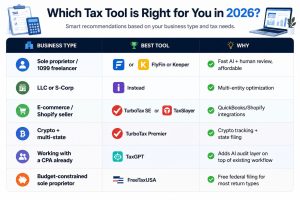
Four questions to ask before picking any tool:
- Does it support your entity type (Schedule C, 1120-S, 1065, etc.)?
- Does it connect to your bank, accounting software, and payment processors?
- Is there a human CPA review option, or is it fully automated?
- What’s the audit support policy if the IRS comes calling?
FAQ: AI Tax Tools for Small Business 2026
Can AI file my business taxes completely on its own?
Mostly, yes , but you’d be smart to have a human review it first. Tools like FlyFin and Instead handle the entire preparation and filing process, but the IRS still holds you personally responsible for every line on your return. No AI vendor will cover your penalties if something goes wrong. The best workflow in 2026 is AI prep + CPA sign-off.
How do AI tax tools find deductions that accountants miss?
Accountants work from whatever you hand them — usually a summary, once a year. AI tools connect to your accounts and scan every transaction as it happens. They catch recurring costs, partial-use expenses, and new deductions that need income-level data. By the time your accountant sees anything, the analysis is already done.
Is it safe to connect my bank account to an AI tax tool?
The reputable platforms (FlyFin, Keeper, Instead, TurboTax) use read-only bank connections , they can see your transactions but can’t move money. They’re also SOC 2 compliant and use bank-level encryption. That said, always check the privacy policy before connecting any financial account.
What’s new in 2026 that AI tax tools already handle?
Quite a bit. The One Big Beautiful Bill Act (signed July 4, 2025) introduced new deductions for tips (up to $25,000) and overtime pay (up to $12,500) for eligible earners, changed rules around employer-provided meals, and restored immediate R&D expensing under Section 174A. Quality AI tax platforms already have these rules baked in.
Do I still need a CPA if I use AI tax software?
For simple returns — probably not. For S-Corps, multi-entity structures, R&D credits, or anything with significant complexity — yes. The sweet spot for most small business owners is using AI software to do 80–90% of the work and then having a CPA do a final review. It’s cheaper than full CPA prep and more accurate than pure DIY.
Can AI help if I’m behind on my taxes?
Yes. Most platforms support prior-year filing. FreeTaxUSA, for instance, offers prior-year filing for filers who’ve fallen behind. If you have R&D expenses from 2022–2024 that were subject to forced amortization, there may also be amended return opportunities — but act fast, since the deadline for certain retroactive relief provisions is July 6, 2026.
The Bottom Line: Stop Overpaying
Look — the IRS is using AI to find problems with your return. It runs the analysis continuously, scores your return automatically, and knows what a business in your revenue range should look like. The playing field has changed.
The good news is that the same technology is available to you, starting at $7 a month. Tools like FlyFin, Instead, and TaxGPT don’t just do what your old spreadsheet did — they work year-round, catch deductions in real time, and build the kind of clean documentation that makes audits a non-event instead of a nightmare.
If you’re a freelancer or Schedule C filer, start with FlyFin. If you run an LLC or S-Corp, look at Instead. If you want maximum guidance and the biggest brand behind you, TurboTax Self-Employed is a solid pick.
Whatever you choose, do it before you actually need it. The best time to start tracking expenses with AI was January 1st. The second-best time is today.
→ Read: Best AI Tools for Small Business Automation in 2026