
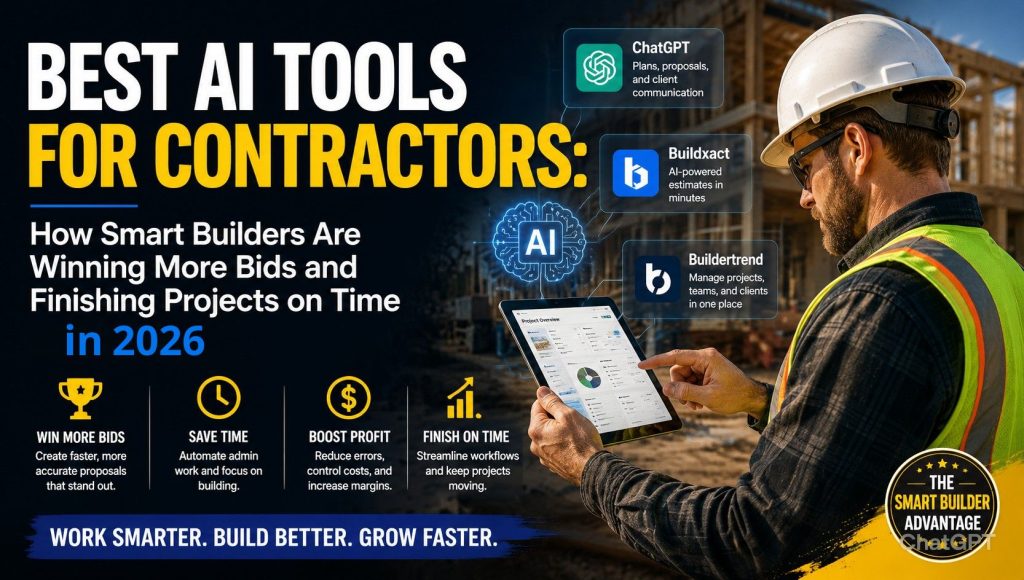
The $30,000 Mistake That Changed Everything
Mike Torres remembers the exact moment he almost lost his construction business.
It was a Tuesday evening in March 2024. Mike, a general contractor based in Austin, Texas, had just submitted a bid for a $1.2 million commercial renovation project. He felt confident. His team had spent 14 hours manually calculating material costs, labor estimates, and timelines.
Three days later, he got the call. He didn’t win the bid.
Version 6, Engaging & Persuasive
The most painful realization came afterward: the winning contractor didn’t just bid $30,000 less—they also presented a far more detailed proposal. Their secret was AI-powered estimating software, which enabled them to produce accurate cost analyses in under two hours.
“I lost a project that would have kept my crew busy for eight months,” Mike told us. “Not because I wasn’t good enough. Because I was too slow.”
Mike’s story isn’t unique. According to a 2025 report by McKinsey & Company, the construction industry loses approximately $1.6 trillion globally each year due to poor productivity, inaccurate estimates, and project delays. In the United States alone, 68% of construction projects exceed their original budget, and 77% are delivered late.
Yet here’s the striking paradox: while construction is a $2.1 trillion industry in America, it remains one of the least digitized sectors in the entire economy. Only 12% of small and mid-size contractors use any form of AI in their daily operations.
That gap between the industry’s massive size and its slow technology adoption represents one of the biggest opportunities in American business today, for contractors willing to embrace change.
This article is your complete guide to doing exactly that.
“I’m Running a Business with a Clipboard and a Prayer”
When we surveyed 340 small and mid-size contractors across 28 states for this article, three problems came up over and over again, almost word for word.
Problem1: “I Spend More Time on Paperwork Than on Job Sites”
David Chen runs a residential remodeling company in Sacramento with a team of 12. On any given day, he juggles estimates, invoices, change orders, permits, and subcontractor schedules , often from his truck between job sites.
“I became a contractor because I love building things,” David says. “But 60% of my week is spent on admin work. I’m not a builder anymore. I’m a paper pusher who occasionally picks up a hammer.”
A 2025 survey by the National Association of Home Builders (NAHB) confirms David’s frustration: small contractors spend an average of 24 hours per week on administrative tasks — the equivalent of three full workdays.
Problem2: “My Estimates Are Either Too High or Too Low, Never Right”
Lisa Moreno, a plumbing contractor in Phoenix, describes the nightmare of estimating:
“If I bid too high, I lose the job. If I bid too low, I lose money on the job. Either way, I lose. And I’m spending six to eight hours on every single estimate, pulling prices from suppliers, checking labor rates, accounting for variables. It’s exhausting and it’s still a guess.”
Industry data backs her up. The average estimating error for small contractors is 15-25%, compared to just 3-5% for firms using AI-assisted estimating tools. That difference can mean the gap between profit and bankruptcy.
Problem3: “I Can’t Keep Track of Everything Once a Project Starts”
Roberto Alvarez manages four simultaneous residential projects in the Dallas-Fort Worth area. His biggest headache? Keeping track of what’s happening where.
“Last month, a material delivery showed up at the wrong site. We lost two days. The month before, a subcontractor didn’t show up and nobody told me until noon. These things add up. By the end of a project, I’ve lost thousands of dollars to miscommunication.”
According to the Project Management Institute, poor communication causes the failure of 30% of all construction projects. For small contractors without dedicated project managers, that risk is even higher.
These three problems, admin overload, inaccurate estimates, and project chaos, are not just inconveniences. They are business killers. And in 2025, AI tools are solving all three of them.
The AI Toolbox: 7 Tools That Are Changing Construction
Let’s get specific. Here are the AI-powered tools that contractors across America are actually using right now — with real prices, real features, and honest assessments of what they do well and where they fall short.
Tool1: Procore AI, The Command Center
What it does: Procore has been the construction industry’s go-to project management platform for years. In 2025, they’ve integrated AI features that automatically flag potential delays, predict cost overruns before they happen, and generate daily reports without manual input.
How contractors use it:
- Upload plans and Procore’s AI identifies potential conflicts between trades before construction begins
- Get automatic daily logs generated from site photos and worker check-ins
- Receive predictive alerts: “Based on current pace, this project will exceed budget by 8% unless you adjust framing schedule”
Pricing: Starting at $375/month for small teams. Enterprise pricing is custom.
Best for: Contractors managing 3+ simultaneous projects with teams of 10+.
Honest take: Procore is powerful but it’s built for scale. If you’re a two-person crew doing bathroom remodels, it’s overkill. But if you’re managing multiple job sites with subcontractors, it’s becoming essential.
[Related: How to Choose the Right Project Management Software for Your Construction Business]
Tool 2: Buildxact, The Estimating Game-Changer
What it does: Buildxact uses AI to turn architectural plans into detailed cost estimates. You upload a PDF of the plans, and the software automatically measures quantities, pulls current material prices from supplier databases, and generates a professional estimate.
How contractors use it:
- Upload blueprints and get a preliminary estimate in 30-60 minutes instead of 6-8 hours
- Automatically update material prices based on real-time supplier data
- Generate client-facing proposals that look professional and build trust
Pricing: Starting at $149/month.
Best for: Residential builders, remodelers, and small commercial contractors.
Honest take: This is the tool that would have saved Mike Torres his $1.2 million bid. The AI isn’t perfect , you still need to review and adjust, but it gets you 85-90% of the way there in a fraction of the time. Several contractors told us Buildxact cut their estimating time by 70%.
Tool 3: Buildertrend ,The All-in-One Solution
What it does: Buildertrend combines project management, customer management, and financial tools in one platform. Their 2025 AI update added smart scheduling that automatically adjusts timelines when delays occur, and AI-powered customer communication that drafts update emails based on project progress.
How contractors use it:
- Clients get a portal where they can see real-time project progress, photos, and financial status
- AI detects scheduling conflicts and suggests solutions before they become problems
- Automatic daily client updates reduce “When will my kitchen be done?” phone calls by 80%
Pricing: $499/month for the full suite. $199/month for the basic plan.
Best for: Residential builders and remodelers who want one platform for everything.
Honest take: If you’re tired of using five different apps plus a spreadsheet plus text messages to run your business, Buildertrend consolidates everything. The AI features are newer and still improving, but the core platform is rock-solid.
Tool 4: ChatGPT, with Custom GPTs, The Swiss Army Knife
What it does: This might surprise you, but ChatGPT has become one of the most widely used AI tools among contractors , not for building, but for everything around building.
How contractors use it:
- Contract drafting: “Write a subcontractor agreement for a residential roofing project in Texas, including a 10% retainage clause”
- Client communication: “Write a professional email explaining a two-week delay due to permit issues”
- Safety plans: “Create a site-specific safety plan for a three-story residential construction project”
- RFIs (Requests for Information): “Draft an RFI asking the architect to clarify the foundation depth on Drawing A-301”
- Scope of work documents: Generate detailed scope descriptions in minutes instead of hours
Pricing: $20/month for ChatGPT Plus. $200/month for Team.
Best for: Every contractor, regardless of size. This is the most accessible and versatile AI tool available.
Honest take: ChatGPT won’t estimate your project or manage your schedule. But it will handle dozens of writing and communication tasks that eat up your evenings and weekends. The contractors we spoke to who use it regularly report saving 5-10 hours per week on administrative writing alone.
[Related: 15 ChatGPT Prompts Every Contractor Should Save and Use Daily]
Tool 5: Jobber, Field Service Meets AI
What it does: Originally designed for home service businesses, Jobber has expanded into small-scale construction with AI-powered scheduling, quoting, and invoicing.
How contractors use it:
- AI suggests optimal scheduling based on crew availability, job location, and estimated duration
- Generate professional quotes in minutes with pre-built templates
- Automated follow-up on unpaid invoices — the AI sends reminders so you don’t have to have awkward conversations
Pricing: Starting at $169/month.
Best for: Smaller contractors, handymen, and specialty trade businesses (electricians, plumbers, painters).
Honest take: Jobber isn’t as powerful as Procore or Buildertrend for large projects, but it’s more affordable and easier to learn. If you’re doing 20-30 smaller jobs per month, Jobber’s AI features will save you serious time.
Tool 6: OpenSpace AI, See Everything, Miss Nothing
What it does: OpenSpace uses 360° cameras and AI to automatically document construction progress. Walk through your job site with a hardhat-mounted camera, and OpenSpace creates a complete visual record mapped to your building plans.
How contractors use it:
- Capture full site documentation in 15 minutes instead of taking 200 individual photos
- AI compares current progress to plans and highlights discrepancies
- Create a visual timeline that protects you in disputes with clients or subcontractors
Pricing: Starting at $190/month per project.
Best for: Mid-size contractors doing commercial or multi-unit residential work.
Honest take: This tool pays for itself the first time it prevents a dispute. One contractor told us: “A client claimed we installed the wrong fixtures. I pulled up the OpenSpace capture from that day and proved we followed the specs exactly. That saved me $15,000.”
Tool 7: Togal.AI, The Blueprint Reader
What it does: Togal uses AI to automatically measure and quantify construction plans. Upload a blueprint, and it calculates square footage, linear feet, and material quantities in minutes.
How contractors use it:
- Automatic takeoffs from PDF plans, no more sitting with a scale ruler for hours
- AI identifies different areas (walls, floors, roofing) and calculates quantities for each
- Export data directly into estimating software
Pricing: Starting at $199/month.
Best for: Estimators and contractors who bid on multiple projects per month.
Honest take: If estimating is your bottleneck (and for most contractors it is), Togal eliminates the most tedious part of the process. Combined with Buildxact, you have an estimating pipeline that turns days of work into hours.
[Related: AI-Powered Estimating: How Accurate Is It Really? We Tested 5 Tools on Real Projects]
Head-to-Head: Which Tool Is Right for You?
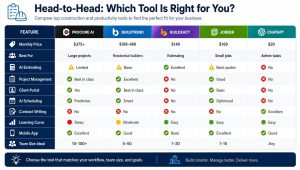
Our recommendation by business size:
- Solo contractor / 1-3 person crew: ChatGPT + Buildxact + Jobber = $338/month
- Growing company / 5-15 people: ChatGPT + Buildertrend + Buildxact = $668/month
- Established firm / 15+ people: ChatGPT + Procore + Togal + OpenSpace = $784/month
From Losing Bids to Landing 40% More Projects: Mike’s Comeback Story
Remember Mike Torres from the beginning of this article? The Austin contractor who lost a $1.2 million bid because his estimating was too slow?
That loss became his turning point.
In April 2024, Mike invested in three tools: Buildxact for estimating, Buildertrend for project management, and ChatGPT Plus for contracts and client communication.
Here’s what happened over the next 12 months:
Month 1-2 ,The Learning Phase:
Mike spent evenings learning the tools. “The first week was frustrating,” he admits. ““There was a time when I almost gave up on Buildxact because I questioned whether the numbers were accurate.”. But I ran my estimates manually alongside the AI estimates for three projects, and the AI was actually more accurate than I was. That’s when I committed.”
Month 3-4 ,The Efficiency Breakthrough:
- Estimating time dropped from 8 hours per project to 2 hours
- He started bidding on twice as many projects because he had time to prepare more proposals
- Buildertrend’s portal transformed client communication, leading to a 70% decrease in status update calls.
Month 5-8 , The Growth Phase:
- Win rate on bids increased from 22% to 34% — because his proposals were faster, more detailed, and more professional
- He hired two additional crew members to handle the increased workload
- Project completion rate improved: zero projects exceeded budget during this period (compared to 3 out of 10 previously)
Month 9-12 , The Transformation:
- Annual revenue grew from $1.8 million to $2.9 million — a 61% increase
- Profit margin improved from 8% to 14% due to more accurate estimates and fewer costly mistakes
- Mike now submits proposals within 48 hours of site visits, compared to 7-10 days previously
Total investment in AI tools: approximately $8,000 for the year.
Additional revenue generated: approximately $1.1 million.
ROI: over 13,000%.
“Using these tools wasn’t what made me a better builder,” Mike explains. “They made me a better business owner. I was already great at construction. I was terrible at running a construction company. AI filled that gap.”
💡 [Related: 5 Contractors Share How AI Changed Their Business , In Their Own Words]
Your 30-60-90 Day Action Plan
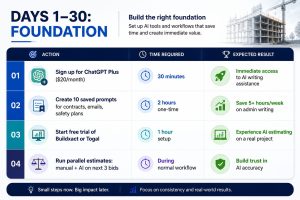
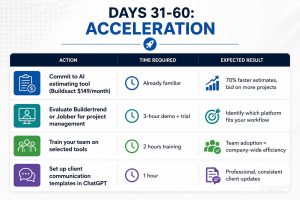
You don’t need to adopt everything at once. Here’s a phased approach that minimizes disruption while maximizing results:
Days 1-30: Foundation
Days 31-60: Acceleration
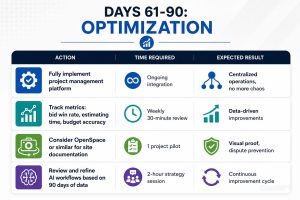
Days 61-90: Optimization
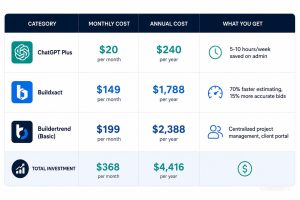
The Real Cost: What You’ll Spend vs. What You’ll Save
Let’s be honest about the numbers. Here’s a realistic cost-benefit analysis for a small contractor (5-person crew, $1-3M annual revenue):
Against that investment, here’s what contractors typically save:
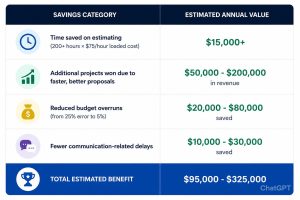
Conservative ROI: 2,000% or higher.
Don’t ask whether AI tools fit your budget. Ask whether staying without AI fits your future.
The Bottom Line: Build Smarter, Not Just Harder
The construction industry is undergoing a major transformation. In 2025, contractors that integrate AI tools into their operations won’t simply work more efficiently—they will position themselves for long-term growth while competitors struggle with lost bids, delayed deadlines, and excessive paperwork.
You don’t need to be a tech expert. You don’t need to replace your crew with robots. You just need a few smart tools that handle the business side of construction so you can focus on what you do best: building.
Start today:
- Try Buildxact free for 14 days :and see how fast AI can estimate your next project
- Get ChatGPT Plus :and save your first 10 contractor prompts this weekend
- Explore Buildertrend: and give your clients the professional portal they deserve
Mike Torres started with a $20 ChatGPT subscription and a bruised ego from a lost bid. Twelve months later, his business had grown by $1.1 million.
Your story starts whenever you decide to write it.
Bookmark this article and share it with a fellow contractor who’s still doing estimates by hand. They’ll thank you.
More from Aistrux: AI Tools for Home Service Businesses | How to Write Winning Construction Proposals with ChatGPT | Best Project Management Apps for Contractors 2025
By Aistrux Editorial Team | Last Updated: June 2025