
A Practical Guide to AI CRM for Growing Businesses in 2026
You Didn’t Start a Business to Chase People Who Already Wanted to Buy From You
A customer reaches out.
You answer quickly.
They seem interested.
You send a proposal.
And then…
Nothing.
No reply.
No response.
No explanation.
A few weeks later, you discover they bought from someone else.
If you’ve experienced this, you’re not alone.
Most small business owners don’t lose customers because they offer bad products or poor service.
They lose customers because somewhere between the first conversation and the final decision, people simply feel forgotten.
And here’s the painful truth:
Your customers don’t remember how hard you’re working behind the scenes.
They only remember how your business made them feel.
Did you respond quickly?
Did you remember their needs?
Did they feel understood?
Did they feel important?
In 2026, customer experience has become one of the biggest competitive advantages for small and medium-sized businesses.
People expect businesses to know who they are, remember previous conversations, and respond at the right time.
They expect personalized experiences.
And when they don’t get them, they leave.
Not because they dislike your business.
But because another company made them feel seen.
This is exactly why more businesses are investing in AI CRM.
Not to replace relationships.
Not to remove the human element.
But to become better at building relationships at scale.
What Is AI CRM?
AI CRM stands for Artificial Intelligence Customer Relationship Management.
At its core, it’s a smarter way of managing customer relationships.
Traditional CRM systems store information.
AI CRM systems help businesses act on that information.
Instead of simply recording customer interactions, modern AI-powered CRM platforms can help businesses:
- Organize customer information
- Identify sales opportunities
- Prioritize leads
- Personalize communication
- Automate follow-ups
- Predict customer behavior
- Improve customer retention
- Reduce repetitive administrative work
The goal isn’t to turn relationships into algorithms.
The goal is to help businesses remember what people matter, when they matter, and why they matter.
Why Are Growing Businesses Suddenly Losing More Customers?
Growth creates complexity.
When your business was smaller, everything was simple.
You remembered every customer.
You knew everyone’s name.
You followed up personally.
You replied immediately.
Then your business started growing.
More inquiries.
More emails.
More appointments.
More proposals.
More conversations.
Suddenly, things begin slipping through the cracks.
Leads go cold.
Customers wait too long.
Opportunities disappear.
And everyone inside the company feels overwhelmed.
The problem isn’t growth.
The problem is that most businesses keep adding customers without upgrading their systems.
Eventually, relationships become difficult to manage.
And when relationships become difficult to manage, revenue becomes difficult to predict.
The Hidden Cost of Forgetting Customers
Most businesses underestimate how expensive poor follow-up really is.
One missed email.
One forgotten phone call.
One delayed proposal.
One customer who doesn’t hear back.
That single moment can cost thousands of dollars.
But the financial cost is only part of the story.
The emotional cost is even bigger.
Customers begin to wonder:
“Do they really want my business?”
“Will they remember me after I buy?”
“If communication is slow now, what happens later?”
Trust starts disappearing.
And trust is incredibly difficult to rebuild.
The businesses winning in 2026 aren’t necessarily the cheapest.
They aren’t always the largest.
They’re often the companies that make customers feel remembered.
Why Customer Relationships Matter More Than Ever in 2026
Customers today have more choices than ever before.
They can compare prices instantly.
They can read reviews instantly.
They can ask ChatGPT, Gemini, or Perplexity for recommendations in seconds.
Products are easier to copy.
Services are easier to imitate.
But trust is still difficult to replicate.
Relationships still matter.
The businesses growing the fastest are often the ones creating experiences that feel personal, responsive, and reliable.
People buy from companies they trust.
People stay with companies that make them feel valued.
And people recommend companies that remember them.
This is where AI CRM becomes incredibly powerful.
Not because it creates relationships.
But because it helps businesses maintain relationships consistently.
Signs That Your Business Might Need an AI CRM
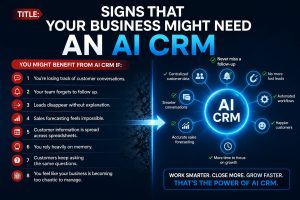
You might benefit from AI CRM if:
- You’re losing track of customer conversations.
- Your team forgets to follow up.
- Leads disappear without explanation.
- Sales forecasting feels impossible.
- Customer information is spread across spreadsheets.
- You rely heavily on memory.
- Customers keep asking the same questions.
- You feel like your business is becoming too chaotic to manage.
If several of these sound familiar, the issue may not be your people.
It may simply be that your company has outgrown its systems.
What an AI CRM Can Help You Improve
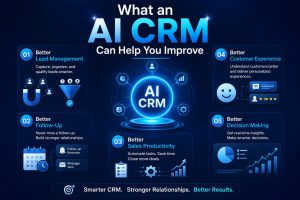
Better Lead Management
Every lead matters.
An AI CRM helps organize inquiries, conversations, notes, and opportunities in one place.
Instead of guessing who needs attention, your team has visibility into every opportunity.
For businesses struggling with lead management, we recommend reading:
Internal Article: Why Do Promising Leads Go Silent Before Becoming Customers?
Better Follow-Up
Timing changes everything.
A customer who doesn’t hear from you may assume you don’t care.
Consistent follow-up builds confidence and trust.
If your team struggles to stay consistent, read:
Internal Article: How Many Sales Are You Losing Simply Because Nobody Followed Up at the Right Time?
Better Sales Productivity
Sales teams shouldn’t spend most of their day updating records.
They should spend more time having meaningful conversations.
Learn more in:
Internal Article: Why Does Your Sales Team Spend More Time Updating Systems Than Closing Deals?
Better Customer Experience
Customers want to feel recognized.
They want businesses to remember who they are and what matters to them.
Explore this topic further:
Internal Article: What Happens When Customers Feel Like They’re Just Another Name in Your Database?
Better Decision Making
Some opportunities are ready today.
Others need more time.
Knowing the difference can significantly improve growth.
Read: What If You Knew Which Leads Were Ready to Buy Before Your Competitors Did?
Popular AI CRM Platforms Used by Businesses in 2026
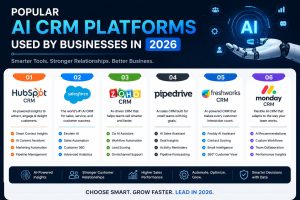
- HubSpot CRM
- Salesforce
- Zoho CRM
- Pipedrive
- Freshworks CRM
- Monday CRM
Official websites:
https://www.freshworks.com/crm/
Each platform serves different business needs, budgets, and levels of complexity.
The right solution isn’t necessarily the most powerful.
It’s the one your team will actually use consistently.
The Real Purpose of AI CRM
At the end of the day, businesses don’t grow because they collect more customer data.
Businesses grow because customers feel heard, remembered, and valued.
Technology doesn’t replace trust.
Technology supports trust.
And as companies continue growing in 2026 and beyond, the businesses that succeed will likely be the ones that use systems to become more human—not less human.
Because customers rarely leave simply because of price.
More often, they leave because they no longer feel connected to the people behind the business.