
Your customer emailed you at 11:47 PM asking about a return policy. You saw it the next morning, at 8 AM, after they’d already left a two-star review and bought the same product from a competitor.
That’s not a customer service problem. That’s a business you’re leaving on the table every single night.
Here’s the part most small business owners get wrong: they think AI customer service means replacing people with cold, robotic chatbots that make customers angrier than if you’d just said nothing. That’s the old version. The 2026 version is different, and the numbers back it up. Small business use of generative AI tools jumped from around 40% in 2024 to over 58% in 2026, according to ColorWhistle’s small business AI research (colorwhistle.com) and customer service is the single biggest reason why.
This guide breaks down exactly what AI customer service tools can do for a business your size, what they cost, what they get wrong, and how to actually implement one without wasting three months and a support budget you don’t have.
What “AI Customer Service” Actually Means in 2026
Forget the decision-tree chatbots from 2019 that made you type “1” for billing and “2” for everything else. Today’s AI customer service tools are built on large language models the same technology behind ChatGPT and they can read a customer’s message, understand the actual intent behind it, pull up order history, and respond in plain language, 24 hours a day.
For a small business, that typically shows up in three forms:
- Website chat widgets that answer FAQs, track orders, and collect leads while you sleep
- Email and ticket triage tools that sort, prioritize, and draft first-response replies
- Voice-based phone agents that answer calls, book appointments, and route anything complicated to a real person
The goal was never to remove humans from customer service entirely. It’s to let AI handle the repetitive 70–80% of questions “what are your hours,” “where’s my order,” “how do I reset my password” so your team (or you, if you’re a team of one) can spend time on the customers who actually need a human.
Why This Matters More for Small Business Than Anyone Else
Enterprise companies have hundred-person support teams. You don’t. That asymmetry is exactly why AI customer service has become a small business story, not just a Fortune 500 one. 64% of small businesses plan to adopt AI chatbots by the end of 2026, up from just 38% in 2024 the fastest adoption curve of any business segment, because small teams have the most to gain per dollar spent.
The math is blunt. Chatbot interactions cost between $0.50 and $0.70 each, while human agent interactions range from $6 to $15 depending on complexity, a 90%+ cost gap per conversation. For a business fielding 500 support conversations a month, that’s the difference between a five-figure annual support bill and a four-figure one, without a single customer noticing a drop in service when it’s built right.
<div class=”pull-quote”>**”AI customer service chatbots can return 340% for small businesses yet 74% of companies that rolled one out have already pulled it offline.”** That gap isn’t about budget or luck. It’s about the five setup decisions covered later in this guide.</div>
The Real Numbers: Adoption, ROI, and Resolution Rates
Let’s get specific, because vague promises are how small businesses end up buying tools they never use.
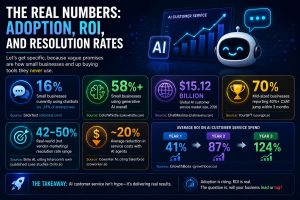
Source:
- SlickText (slicktext.com)
- ColorWhistle (colorwhistle.com)
- ChatMaxima (chatmaxima.com)
- YourGPT (yourgpt.ai)
- Brilo AI, citing Intercom’s own published case studies (brilo.ai)
- Coworker AI, citing Salesforce (coworker.ai)
- GrowthBoss (growthboss.co)
Notice the gap between the 42–50% real-world resolution rate and the flashier 70–80% numbers you’ll see in vendor sales decks. That gap matters. Brilo AI’s research found that headline resolution rates are often vendor-reported averages, while the same vendors’ own published customer case studies show a more conservative, realistic range. Build your budget around the conservative number, not the pitch deck.
What AI Chatbots Are Good At – and What They Still Get Wrong
This is the section most articles skip, and it’s the one that actually saves you money.
What they’re genuinely good at:
- Answering repetitive questions instantly, any time of day
- Qualifying leads before they hit a human’s inbox
- Reducing average first-response time from hours to under a minute
- Handling order status, appointment booking, and basic troubleshooting
Where they still fall short, and why it matters:
According to GrowthBoss’s 2026 ROI research, three in five consumers will only repeat themselves once to an automated system before giving up entirely. If the bot misunderstands them twice, they’re gone and here’s the part that should worry any small business owner: 56% of frustrated customers simply stop doing business with you without ever complaining (growthboss.co). You won’t get an angry email. You’ll just quietly lose repeat customers and not know why.
There’s also a real privacy risk worth taking seriously. The same research found that in 31% of documented chatbot failure cases, the bot disclosed a customer’s personal information mid-conversation not a minor bug, but a genuine legal exposure issue for any business handling payment or account data.
The fix isn’t “don’t use AI.” It’s: always build an easy, visible path to a human, and never deploy a bot on sensitive account or payment conversations without a tested escalation rule.
A Real-World Look at the Cost Savings
Numbers on a page are easy to ignore. Here’s what they look like in practice.
GrowthBoss documented a support operation that pushed its automation rate to 89%. Cost per ticket dropped from $5.50 to $2.00 — a 63% reduction and response times fell from hours to under a minute (growthboss.co). That’s not a rounding error. For a small business handling even 500 support tickets a month, that’s the difference between needing to hire a second support person and not needing to for another two years.
A separate case in the same research: a B2B SaaS company automated 78% of its customer onboarding questions, cut time-to-value for new customers by 40%, and reduced churn as a direct result of faster, always-available answers during the first critical weeks of a customer relationship.
The pattern across both cases is the same: the savings don’t come from replacing people. They come from removing the repetitive questions that were eating your team’s time before a human ever got involved.
How to Know if Your Business Is Ready

AI customer service isn’t a fit for every business at every stage. Ask yourself these three questions before you buy anything:
- Do you get the same 10–15 questions over and over? If your inbox is full of repeat questions, that’s the clearest signal an AI tool will pay for itself fast.
- Do you lose business outside business hours? If customers are emailing or messaging at night and weekends, an AI tool captures revenue you’re currently losing.
- Can you commit to at least 3–4 weeks of setup and monitoring? The businesses that fail with AI customer service almost always skipped the setup phase feeding the bot a real FAQ, real policies, and a real escalation path.
If you answered yes to at least two of these, you’re a good candidate. If not, start with our guide on picking the right AI tool stack for your specific business type before jumping straight to chatbots.
Real Small Business Case Studies, Not Vendor Fairy Tales
Case 1 B2B SaaS onboarding:
A small B2B SaaS company pointed its AI agent specifically at onboarding questions instead of general support. Result: 78% of onboarding questions automated, time-to-value for new customers cut by 40%, and churn down 18%. The lesson: the bot didn’t just deflect tickets it made customers successful faster, which is a retention outcome dressed up as a support outcome.
Case 2 Multi-location clinic scheduling:
A clinic chain deployed AI specifically for appointment scheduling and FAQs across 12 locations. Result: four hours of daily phone work eliminated per receptionist, or 48 hours of human time recovered per day across the group time redirected to patient care instead of hold-music duty.
Case 3 Automotive service booking:
In the automotive sector, where more than 90% of North American dealerships now run chat support, AI bots handle the predictable split: 31% new-vehicle questions, 28% service appointment bookings, 20% used-car inquiries resolving about 90% of incoming questions without a human, and routing only the genuinely complex 10% to staff with full context attached.
The pattern across all three: none of these businesses tried to automate everything. They picked a specific, high-volume, well-documented task category and let AI own that lane completely.
What It Actually Costs: Real 2026 Pricing, Not Marketing Numbers
This is where most guides get vague. Here’s the real math, platform by platform, based on current 2026 pricing.
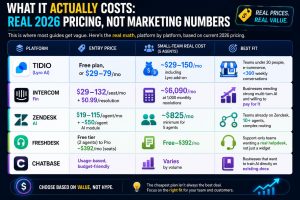
A useful reference point: according to Juniper Research’s 2025 AI in Customer Service study, AI chatbots save businesses an average of $8 per customer interaction compared to human-only support — meaning a business handling 500 monthly conversations is looking at roughly $4,000/month in potential savings, which comfortably outpaces every tool on this list.
The trap to avoid: paying for a full customer-service suite (Zendesk, Intercom) when you only actually use the chat widget and AI replies. That’s the single most common small-business mistake in this category, and it’s why the cheaper, purpose-built tools (Tidio, Chatbase) often out-earn their price tag for teams under 20 people.
The 5 Decisions That Separate Success From the 74% Failure Rate
- Scope it narrowly first. Don’t launch a bot meant to “handle customer service.” Launch one meant to handle order status and return policy. Expand from a working narrow deployment, not a broad shaky one.
- Build the escape hatch before launch. Every successful deployment above had a clean, fast human handoff. A bot with no visible way out is the single biggest driver of the negative reviews behind that 74% shutdown rate.
- Feed it real documentation, not marketing copy. AI resolution accuracy tracks directly with the quality of the source material it’s trained on a thin FAQ page produces a thin bot.
- Set a realistic resolution target. Rule-based bots land at 30–40% resolution. Pre-built AI tools like Tidio Lyro or Intercom Fin land at 40–65%. Well-configured custom builds can reach 60–80%. Anyone promising 95%+ out of the box for a general-purpose small business bot is not being straight with you.
- Review real conversations weekly for the first two months. The businesses in the 340% ROI column treated launch as version one, not a finished product.
Where AI Customer Service Fits Into Your Broader Stack
Support automation doesn’t live in isolation it connects to your CRM, your booking system, your inventory, and increasingly your marketing automation. If you’re evaluating this as part of a wider AI toolkit decision, our related guides go deeper on adjacent pieces: see our breakdown of AI Chatbot Platforms Compared: Zendesk vs. Intercom vs. Tidio vs. Freshdesk for a head-to-head on the tools mentioned above, our How Much Does an AI Chatbot Cost? Full 2026 Pricing Breakdown for line-by-line budgeting, our AI Customer Service ROI Calculator & Case Studies for building your own business case, and our How to Train an AI Chatbot on Your Business Data guide for the setup work that determines whether you land in the 340% column or the 74% one.
FAQs
Does an AI chatbot replace my customer service team? No, and businesses that try this usually see satisfaction scores drop. The realistic model is AI handling routine, repetitive questions while your team focuses on complex or emotionally sensitive conversations.
How much does an AI customer service chatbot cost for a small business? Costs vary widely by tool and volume. We break down real 2026 pricing tiers, from free options to enterprise-grade platforms, in our dedicated AI chatbot cost guide.
Is an AI chatbot better than hiring a virtual assistant? It depends on your ticket volume and the complexity of your customer questions. We compare both paths honestly in AI Chatbot vs. Live Chat vs. Hiring a Virtual Assistant.
Is AI customer service worth it for a business with under 10 employees? Usually yes, if support volume is at least a few dozen conversations a week and the questions are repetitive. Below that volume, the cost-per-resolution math doesn’t clear the bar, and a well-organized FAQ page may do the job just as well.
Will customers know they’re talking to a bot? Best practice , and increasingly a matter of law in some states is disclosing it upfront. The 87% satisfaction figure for AI chat interactions in 2026 held up specifically because most well-run deployments are transparent and offer a fast path to a human.
How long does setup actually take? Purpose-built tools like Tidio can be live within hours. Custom-trained deployments on your own documentation typically take one to three weeks to reach a stable, trustworthy resolution rate.
What’s the biggest hidden cost? Per-resolution pricing (like Intercom Fin’s $0.99/resolution) scales with success the better the bot performs, the higher the bill. Budget for growth, not just the entry-tier number on the pricing page.
How long does it take to set up an AI chatbot? A basic setup can go live in a day. A properly trained one fed with your actual FAQs, policies, and escalation rules takes closer to 2–3 weeks to get right. Our step-by-step setup guide walks through the full process.
Where to Go Next
This pillar guide covers the big picture. If you’re ready to go deeper, here’s where to head next:
- Best AI Chatbot Tools for Small Business in 2026 real comparisons, not just vendor lists
- How Much Does an AI Chatbot Cost for a Small Business? full 2026 pricing breakdown
- AI Chatbot vs. Live Chat vs. Hiring a Virtual Assistant which one actually fits your business
- How to Set Up an AI Chatbot for Your Small Business Website a step-by-step walkthrough
You might also want to check our broader guide on the best AI tools for small business in 2026 and how AI fits into marketing automation for small businesses.
Sources: ColorWhistle, Coworker AI, YourGPT, ChatMaxima, SlickText, Brilo AI, and GrowthBoss, all 2026 industry research.