
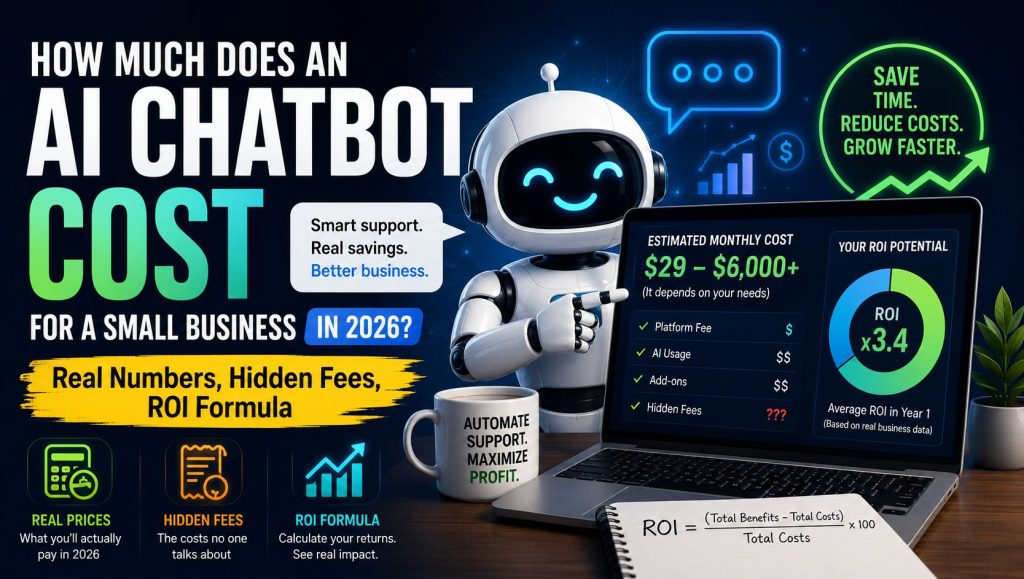
Here’s the question every vendor dodges: not “what’s your starting price,” but “what will I actually pay after month three.” According to Forrester’s 2025 CX report, 68% of companies that abandoned a chatbot investment cited unexpected costs as the reason, not a technical failure, not poor performance, just a bill that didn’t match what they signed up for, as cited in Heeya’s 2026 pricing guide (heeya.fr).
That’s the gap this article closes. We’re not going to tell you “AI chatbots start at $19/month” and leave it there. We’re going to show you the real first-year cost, the six fees nobody puts on the pricing page, and a formula you can plug your own numbers into before you sign anything.
If you haven’t picked a tool yet, start with our comparison of the best AI chatbot tools for small business. This article assumes you’re ready to budget for one.
Table of Contents
- Real 2026 price ranges by budget tier
- The six hidden costs nobody puts on the pricing page
- What a chatbot actually costs in year one
- The ROI formula (and how to use it)
- Three worked examples at different volumes
- A real case study
- How much should you actually spend?
- FAQs
Real 2026 Price Ranges by Budget Tier
The honest answer is that AI chatbot pricing spans from completely free to well over $50,000, and the gap isn’t random — it’s driven by pricing model, customization level, and conversation volume, according to Heeya’s full-spectrum pricing breakdown (heeya.fr).
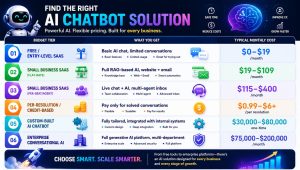
For a small business with under 1,000 monthly support contacts, the $19–$109/month range is genuinely sufficient, per Heeya’s SaaS pricing analysis (heeya.fr). The trap to avoid is per-conversation billing, which can quietly push costs to $500–$2,000/month at even moderate volume a pattern confirmed across multiple 2026 pricing audits.
The Six Hidden Costs Nobody Puts on the Pricing Page
According to SiteGPT’s 2026 pricing comparison, which analyzed real costs across seven platforms at both 1,000 and 5,000 conversation volumes, the pricing model you choose matters more than the vendor’s advertised starting price the difference between a flat-rate and per-resolution model can be as much as 63x over three years, with identical product capability (sitegpt.ai). Here are the six hidden costs driving that gap:
- The scaling paradox. A viral post, a marketing campaign, or a product outage can double your conversation volume in a single week, and if you’re on a per-conversation plan, your bill doubles with it, right when you can least afford surprises.
- Setup and training costs. Many platforms charge extra to configure your knowledge base or provide onboarding support. These fees range from $0 to $5,000+ depending on the platform and how much of your content needs structuring.
- Human escalation fees. Some platforms charge separately for every conversation the AI hands off to a human — meaning you pay twice for a single customer interaction: once for the AI attempt, once for the human resolution.
- Integration costs. Connecting your chatbot to your CRM, help desk, or inventory system often isn’t included in the base price, and can add anywhere from a few hundred to several thousand dollars depending on complexity.
- Implementation time and training hours. According to SUCCESS magazine’s 2026 breakdown of true AI costs, the advertised monthly subscription price typically represents only 20% to 40% of the true first-year cost once you factor in setup hours, staff training time, and workflow disruption (success.com).
- Branding and white-label removal fees. Several platforms lock “remove our logo from your chat widget” behind a separate paid add-on a small line item that still needs to be in your budget if brand presentation matters to you.
What a Chatbot Actually Costs in Year One
This is the number that matters, and it’s rarely the number on the homepage. Here’s how SUCCESS magazine’s first-year cost model breaks down for a customer service chatbot specifically:
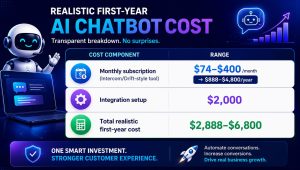
That’s a useful example because it shows the pattern clearly: the sticker price on the pricing page is often less than half of what you’ll actually spend once integration is included, per SUCCESS’s 2026 AI cost research (success.com). The formula they recommend running before you commit to any AI tool:
Total First-Year Cost = (Monthly Subscription × 12) + (Setup Hours × Your Hourly Rate) + (Training Hours × Your Hourly Rate) + (Lost Productivity During Rollout)
Run your own numbers through that formula before comparing vendors on sticker price alone.
The ROI Formula, and How to Use It
Every chatbot vendor claims their product “pays for itself.” Almost none show the math. Here’s the formula worth using instead, drawn from getclaw’s 2026 ROI framework (getclaw.sh):
ROI (%) = ((Annual Savings + Revenue Gains − Total AI Costs) / Total AI Costs) × 100
Three inputs feed that formula:
- Deflection rate , the percentage of incoming conversations the bot resolves entirely on its own, without human involvement. Formula: (Tickets resolved by bot ÷ Total tickets) × 100. Per Solvara’s 2026 ROI breakdown, top-performing bots hit 70–80% deflection, while average, poorly-configured bots sit closer to 30–40% (solvara.tech).
- Cost per interaction. The industry-average cost of a single human-handled support interaction in 2026 ranges from $5 to $25 depending on channel and complexity, according to getclaw’s cost benchmarking (getclaw.sh). Compare that against your chatbot’s per-conversation cost, and the savings per deflected ticket becomes the core of your ROI case.
- Revenue gains (optional, but real). AI chatbots that guide customers through purchase decisions increase conversion rates by an average of 23%, per getclaw’s 2026 industry data (getclaw.sh). For an e-commerce or SaaS business, even a modest 5% conversion lift can add $10,000–$50,000 a year in revenue, depending on average order value and traffic. For a conservative business case, count savings only revenue gains are real but harder to attribute cleanly.
One important warning: deflection rate alone is a misleading metric. A ticket the bot “closes” but the customer reopens an hour later wasn’t actually resolved it was delayed. Model your ROI on tickets the AI genuinely resolves end to end, not just ones it technically closed.
Three Worked Examples at Different Volumes
Numbers mean more with real scenarios attached. Here are three, based on documented 2026 modeling from Heeya’s ROI calculator (heeya.fr) and Solvara’s deflection-savings breakdown (solvara.tech):
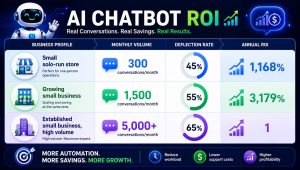
For context on how that scales: a mid-sized business handling 8,000 monthly support tickets at a 60% deflection rate, with a blended human ticket cost of $6 versus a $0.50 chatbot cost, saves roughly $5.50 per deflected ticket which works out to about $26,400 a month, or over $316,000 a year, according to Solvara’s calculation model (solvara.tech).
Even at much smaller scale, the math holds up. A business handling 1,000 weekly support requests at 80% automation, with a $3 manual-handling cost per interaction, saves approximately $124,000 annually, per Elfsight’s 2026 pricing research (elfsight.com) though it’s worth noting that independent, SMB-specific ROI studies confirming this exact figure remain limited, so treat it as a directional estimate rather than a guarantee.
A Real Case Study
Numbers from a spreadsheet are one thing. Here’s a documented, real-world deployment: the London Borough of Barking & Dagenham implemented a multi-department AI assistant and reduced costs by approximately £48,000 within six months, while customer satisfaction rose by 67%, according to Master of Code’s 2026 chatbot pricing research (masterofcode.com).
The lesson isn’t “public sector AI works,” it’s that the biggest gains came from automating the routine, repetitive requests that were consuming staff time before the AI was ever involved — the same pattern that shows up across every small business case study in this space. The size of the organization changes the scale of the numbers, not the underlying mechanism.
Scale that logic down to a business with one-tenth the ticket volume of a local government department, and the proportional savings hold up remarkably well a few thousand dollars a month in staff time, rather than tens of thousands, but the same 60–70% reduction in time spent on repetitive requests. That consistency across very different organization sizes is exactly why the ROI formula in this guide works regardless of whether you’re running a five-person shop or a fifty-person operation the inputs scale, but the math doesn’t change.
How Much Should You Actually Spend?
Use this as your decision framework instead of picking a number out of thin air:
- Under 300 conversations/month, tight budget → Start with a free or ~$19/month flat-rate tool. Prove the concept before spending more.
- 300–2,000 conversations/month → Budget $29–$150/month for a flat-rate or conversation-based plan. Avoid per-resolution pricing at this volume — it usually costs more than it saves.
- 2,000–5,000+ conversations/month → This is where per-resolution or premium tools like Intercom Fin can make sense, if your deflection rate and cost-per-interaction math genuinely supports it. Run the ROI formula above before committing.
- You’re comparing a custom build vs. an off-the-shelf SaaS tool → A custom AI chatbot ($30,000–$80,000+) rarely makes sense for a small business unless you have very specific integration needs that no SaaS platform covers. Start with SaaS; only consider custom once you’ve outgrown it. Our guide to AI chatbots vs. hiring a virtual assistant covers this build-vs-buy-vs-hire decision in more depth.
Whatever tier you land in, run a small proof-of-concept before a full rollout. It’s the single most effective way to validate your use case and avoid the 68% “unexpected costs” trap covered earlier in this guide.
Questions to Ask Before You Sign Anything
Most pricing surprises happen because small business owners ask “how much does it cost” and stop there. Ask these instead, and get the answers in writing before you enter payment details:
- “What happens to my bill if conversation volume doubles for a month?” This surfaces per-resolution and credit-based traps immediately. A vendor with a genuinely flat-rate model will answer this in one sentence. A vendor dodging the question is telling you something.
- “Is setup and knowledge-base training included, or billed separately?” Get a number, not a “it depends.” As covered above, setup fees alone can range from $0 to $5,000+.
- “Do you charge extra when the AI hands off to a human?” This is the double-billing trap. If yes, factor that into your per-conversation math, not just your subscription line.
- “What does removing your branding from the chat widget cost?” Often a separate add-on, and worth knowing before it becomes a surprise on your third invoice.
- “Can I see a real customer’s resolution rate, not your marketing page’s number?” Ask for a reference call if the vendor won’t share this. A vendor confident in their real-world performance will connect you with an existing customer.
- “What’s the cancellation and data-export process if this doesn’t work out?” You want your FAQ content and conversation history in a format you can move to a new platform, not locked into one vendor’s system.
Annual vs. Monthly Billing: Does It Actually Save Money?

Most platforms offer a 15–20% discount for annual billing over monthly, which sounds like an easy win but it’s only a good deal if you’re confident in the platform after your trial period. Committing to a year upfront before you’ve validated real-world resolution rates against your actual FAQ content is how businesses end up locked into a tool that isn’t the right fit, with no easy way out. The safer sequence: run one to two months on the monthly plan first, confirm your deflection rate and cost savings hold up with real customers, then switch to annual billing once you trust the number.
FAQs
What’s the cheapest real AI chatbot for a small business? Several platforms offer a genuine AI-powered free tier or a $19/month flat-rate plan with meaningful conversation limits — enough for most businesses under 300 monthly conversations to validate fit before spending more.
Is per-resolution pricing ever a good idea for a small business? Only at low, predictable volume. Per-resolution pricing looks cheap on the homepage but can become one of the most expensive models at scale — sometimes 63x more expensive over three years than a flat-rate plan with the same capability, according to 2026 pricing research.
How do I calculate whether an AI chatbot will actually save my business money? Use the ROI formula: ((Annual Savings + Revenue Gains − Total AI Costs) / Total AI Costs) × 100. The two inputs that matter most are your deflection rate and your cost per human-handled interaction, which typically ranges from $5 to $25.
Do small businesses really see this kind of ROI, or is it mostly vendor marketing? Both are true at once. The deflection-rate math is real and independently verifiable — savings genuinely do compound as automation handles more conversations without proportional cost increases. But vendor-reported headline numbers (“80% resolution,” “reduce costs by 80%”) are usually more optimistic than real-world results, so always ask for a case study with real numbers, not a marketing claim.
What’s the single biggest mistake small businesses make when budgeting for a chatbot? Comparing only the advertised monthly price. As covered above, that number is often 20–40% of the true first-year cost once setup, training, and integration are included. Always calculate total first-year cost before comparing platforms.
Should I negotiate pricing with AI chatbot vendors, or is it fixed? For SaaS platforms under a few hundred dollars a month, pricing is usually fixed and non-negotiable. Once you’re evaluating enterprise-tier platforms or custom builds in the tens of thousands of dollars, pricing is almost always negotiable — vendors at that level expect a procurement conversation, not a credit-card checkout. If a sales rep quotes you a five-figure number, treat the first quote as a starting point, not a final price.
For the tool-by-tool pricing behind these numbers, see our best AI chatbot tools for small business comparison, and for the bigger-picture strategy question, our complete AI customer service guide.