
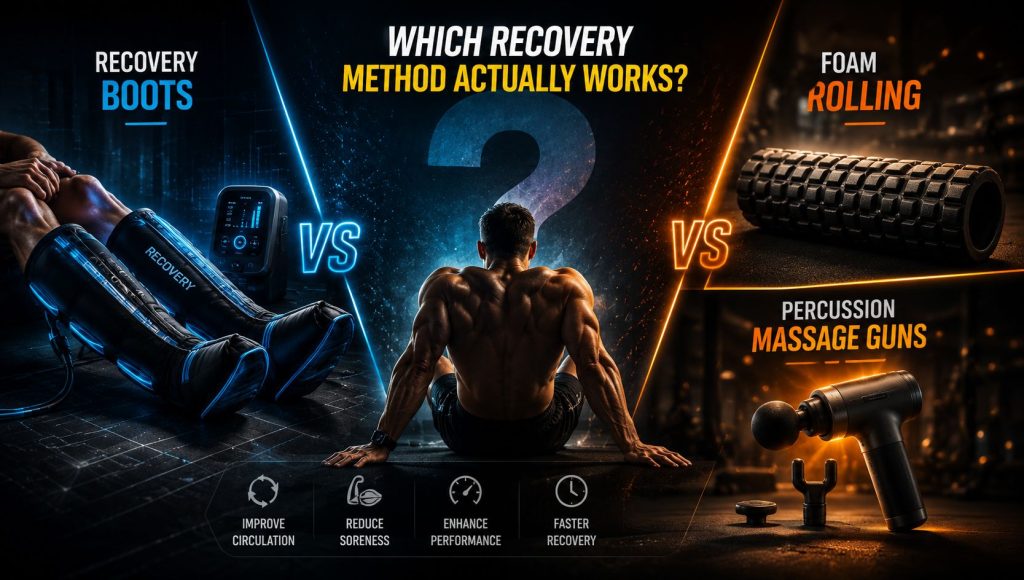
Walk into any well-equipped home gym in 2026 and you’ll likely find all three: a pair of compression boots in the corner, a foam roller under the bench, and a massage gun charging on the shelf. That’s not redundancy it’s a sign that these three tools solve genuinely different problems, and the common question we hear “which one should I actually buy” usually has the wrong premise baked in. The better question is which one solves your specific recovery bottleneck, because in most well-built recovery stacks, the answer ends up being more than one.
Here’s an honest, mechanism-first breakdown of what each tool actually does, where the evidence is strong versus weak, and how to decide what’s worth your money.
The Core Mechanical Difference
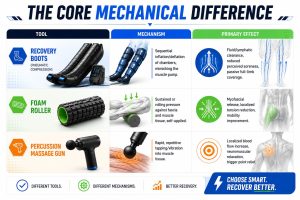
If you’ve ever wondered why gym bags these days are stuffed with gadgets instead of just a towel and a water bottle, recovery tools are the reason. Take recovery boots those inflatable leg sleeves you might’ve seen pro athletes wearing on the sidelines. They work by squeezing and releasing air through different chambers, basically doing the job your calf muscles do when you walk, pushing fluid back up toward your heart. The payoff? Less puddling in your legs, less of that heavy, achy feeling the next day, and you don’t even have to move just strap in and scroll your phone while it does the work.
Foam rollers are the low-tech cousin in this lineup, and honestly, they’ve earned their spot in gym bags for a reason. You’re using your own body weight to roll out tight spots in your muscles and the connective tissue around them. It’s not comfortable in the moment anyone who’s rolled out a tight IT band knows that but it loosens things up, breaks up knots, and leaves you moving easier than when you started.
Then there’s the massage gun, the one that sounds like a tiny jackhammer and gets side-eyed on airplanes. It fires off quick pulses into your muscle, and that rapid tapping gets blood moving to the area, calms down overworked nerves, and can zero in on those stubborn knots that never seem to work themselves out.
None of these tools do the exact same job. Recovery boots are your set-it-and-forget-it option, foam rollers give you control over exactly where you dig in, and massage guns are great for hitting one cranky spot fast. Most people end up mixing and matching depending on what their body’s asking for that day.
These aren’t interchangeable. A foam roller requires active effort and body positioning you’re doing the work. A massage gun requires targeting a specific spot with a handheld device. Recovery boots require nothing except putting them on and sitting still, which is precisely why they cover full-limb fatigue better than the other two, but can’t replicate the targeted, deep-pressure release a massage gun or foam roller provides on a specific knot or trigger point.
Recovery Boots: Best For Whole-Limb, Passive Recovery
Recovery boots excel when the problem is diffuse fatigue across a large muscle group or entire limb — the kind of soreness you get after a long run, a heavy leg day, or a long day on your feet. Their biggest advantage is that they require zero active effort: you sit down, you do something else (work, watch TV, scroll), and the compression happens passively for 15–30 minutes.
Where they fall short: they can’t address a specific, localized knot or trigger point the way a massage gun can. If your problem is “my left glute has one specific tight spot,” compression boots will help with general circulation but won’t provide the targeted deep-tissue release that fixes that spot directly.
We go deeper on the mechanism and evidence base in our piece on how pneumatic compression recovery boots actually work.
Foam Rolling: Best For Mobility and Fascial Tension
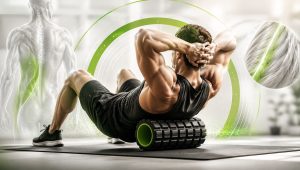
Foam rolling has the longest track record of the three and a reasonably solid evidence base for short-term improvements in range of motion and perceived muscle soreness, particularly when used before activity as part of a warm-up. Its real value is in targeting fascial restrictions and specific tight bands of muscle through direct, controllable pressure.
Where it falls short: it’s effort-intensive (you’re doing the physical work of applying and sustaining pressure), time-limited by discomfort tolerance, and less effective on very large muscle groups like the entire quad or hamstring where sustained even pressure is hard to maintain through self-application. It’s also poorly suited to areas that are awkward to reach or position correctly, like certain hip and glute angles.
Percussion Massage Guns: Best For Targeted Trigger Points and Pre-Activity Activation
Massage guns shine in a narrow but valuable use case: rapid, localized treatment of a specific tight spot or trigger point, often used as a pre-workout activation tool (a minute or two on a muscle group before training) or a quick spot-treatment after activity. The rapid percussive action increases local blood flow and can reduce the sensation of tightness quickly often in under two minutes per area.
Where they fall short: they’re not designed for sustained, whole-limb sessions the way recovery boots are most manufacturers recommend limiting use to 1–2 minutes per muscle group, and prolonged use on the same spot can cause bruising or tissue irritation. They also require the user to hold and maneuver the device, which becomes tiring during longer sessions, and they can’t be used passively while doing something else the way recovery boots can.
Head-to-Head: Which One Wins for Which Scenario
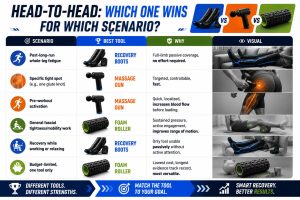
So which one should you actually reach for? It depends on what your body’s dealing with. If you just crushed a long run and your whole legs feel like dead weight, recovery boots are the move they cover the entire limb without you having to lift a finger, which is exactly what you want when you’re too wiped to do anything else. But if it’s more like one specific spot causing trouble say, a stubborn knot in one glute that’s been bugging you for days that’s where the massage gun shines. It lets you zero in on exactly the right spot, and you can feel it working almost instantly.
Getting ready to work out is another story entirely. Before you load up on weight or start sprinting, a quick pass with the massage gun can wake up the muscle and get blood flowing to the area, priming it for what’s coming. On the flip side, if what you’re really after is loosening up tight fascia or improving how well you move overall, foam rolling is your best bet it takes some real effort on your part, but that active engagement is exactly what makes it so effective for mobility.
Here’s a nice perk of recovery boots too: they’re the only option here you can use while doing something else. Working at your desk, watching TV, scrolling through your phone none of that has to stop for the boots to do their thing. That kind of hands-off recovery is hard to beat when your day’s already packed.
And if you’re only willing to invest in one tool because budget’s tight, foam rollers win, hands down. They’re the cheapest option, they’ve been around long enough that there’s solid research backing them up, and they can handle just about anything you throw at them tight hips, cranky shoulders, sore quads, you name it. It won’t replace what boots or a massage gun can do in their specific lanes, but as an all-around workhorse, it’s tough to top.
Building a Combined Recovery Stack
In practice, the strongest home recovery setups use all three in sequence rather than picking one:
- Massage gun: brief targeted work on any specific tight spots (1–2 minutes each)
- Foam rolling: broader fascial work across major muscle groups (5–10 minutes)
- Recovery boots: passive full-limb session while doing something else (15–30 minutes)
This sequencing moves from targeted and active to broad and passive, which mirrors how most physical therapists structure manual recovery work address specific problem areas first, then broader tissue work, then passive circulation support.
The ROI Question: What’s Actually Worth Buying First
If you’re building a recovery stack from scratch and budget is limited, the honest ranking by cost-to-benefit is:
- Foam roller: lowest cost (often under $40), strongest general evidence base, most versatile across body parts
- Massage gun: mid-cost ($100–$300), best for targeted relief and pre-workout activation
- Recovery boots: highest cost ($300–$1,000+), best for passive full-limb sessions and consistent whole-leg fatigue management
For most people starting out, a foam roller and a mid-tier massage gun cover the majority of recovery needs at a fraction of the cost of a premium compression setup. Recovery boots become the higher-value addition once training volume increases to the point where whole-limb fatigue — not just localized tightness — becomes the limiting recovery factor. Our full recovery boots comparison breaks down which specific units are worth that step up.
None of these tools is objectively “better” in isolation, they solve different problems. Foam rolling and massage guns are active, targeted, lower-cost tools best suited to specific tightness and mobility work. Recovery boots are a passive, full-limb tool best suited to diffuse fatigue and consistent post-training soreness management. The strongest recovery stacks use all three with intention, matched to the specific problem each is solving, rather than treating them as competing purchases.