
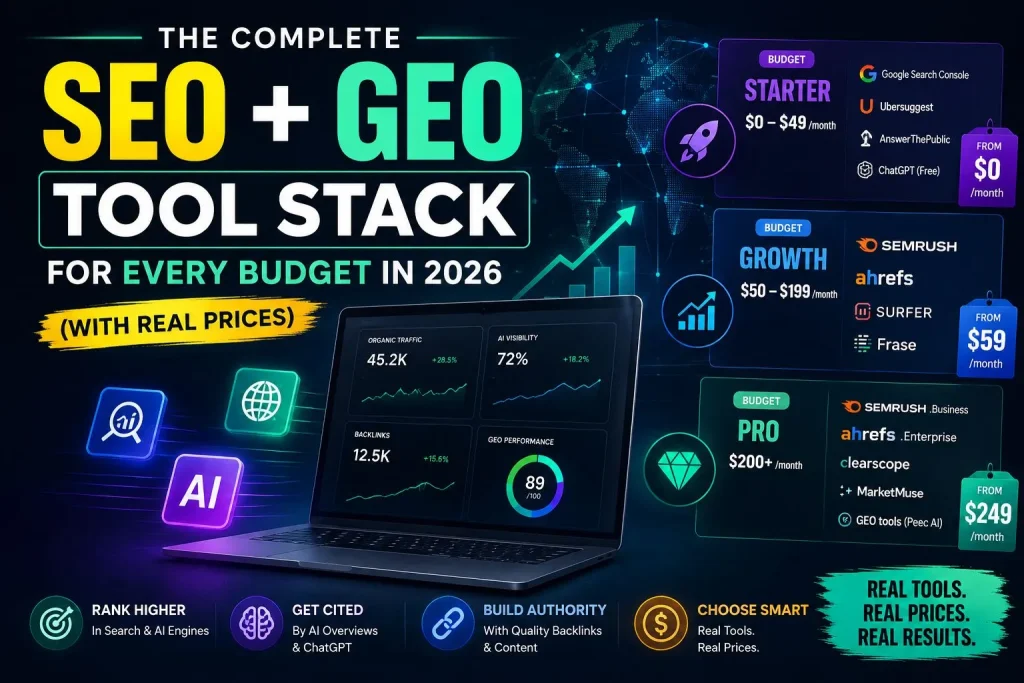
Open ten “best SEO tools” roundups and you’ll find the same problem ten times: forty tools, no prices you can trust, and zero guidance on which five you actually need at your budget. This isn’t that list. This is the exact stack — tool by tool, price by price — for three real budget bands, built as a companion to our budget-based decision framework for choosing between SEO and GEO spend in the first place.
If you already read that guide, you know the split: Bootstrap under $150/month, Growth $150–$750, Scale $750–$3,000+. Here’s exactly what to buy at each level.
Tier 1: Bootstrap Stack (Under $150/month)
At this budget, you’re buying one tool and doing the rest with free resources and consistent effort.
Core SEO tool: Surfer SEO Discovery or Semrush’s entry plan. <cite index=”63-1″>Surfer SEO’s pricing currently ranges from roughly $89 to $219 a month depending on the plan</cite>, with <cite index=”62-1″>its lowest Discovery tier built specifically for individual bloggers, freelancers, and very small businesses publishing a low volume of content, covering keyword research, a content editor, and basic audits</cite>. If you’d rather have keyword research and rank tracking bundled with content guidance in one place, <cite index=”61-1″>Semrush’s entry plan starts around $40/month</cite>, though <cite index=”64-1″>G2 lists Semrush’s Pro plan at $139.94/month as its more commonly reviewed small-business entry point</cite> — check current pricing directly, as tiers shift.
What you skip entirely at this budget: dedicated GEO monitoring tools, paid backlink outreach platforms, and any tool billed per-seat. You don’t have the content volume yet to make monitoring worthwhile.
What you do for free:
- Google Search Console and Google Business Profile (both free, both essential — don’t skip either)
- Manual AI visibility checks: once a month, ask ChatGPT and Perplexity your top 5–10 buyer questions directly and log what they say about you and your competitors in a simple spreadsheet
- Schema.org markup added by hand to your site’s Organization, Article, and FAQ pages — this is a one-time technical task, not a subscription, and it’s the single highest-leverage free move available for future GEO visibility
Total realistic monthly cost: $89–$150
Tier 2: Growth Stack ($150–$750/month)
This is where a real GEO monitoring tool enters your stack, layered on top of a more capable SEO setup.
Core SEO tool: Semrush or Ahrefs mid-tier. <cite index=”61-1″>Ahrefs’ entry pricing starts around $129/month</cite> and remains the stronger choice if backlink data and competitor gap analysis matter most to your strategy. Semrush at its Pro tier covers a broader mix of keyword tracking, site audits, and content tools in one subscription — useful if you’d rather consolidate than run two logins.
Content optimization add-on (optional): Surfer SEO Standard. <cite index=”64-1″>Surfer’s Standard plan starts around $99/month</cite> and is worth adding once you’re publishing consistently enough that per-article content scoring saves real editorial time — <cite index=”59-1″>below roughly four articles a month, the per-article math on a dedicated content tool rarely justifies the cost</cite>, so hold off until your publishing cadence catches up.
GEO monitoring tool: Otterly.ai Lite or Standard. <cite index=”46-1″>Otterly.ai’s pricing runs $29–$489/month depending on tier</cite>, and <cite index=”44-1″>its Lite plan at $29/month tracks 15 prompts across four engines: ChatGPT, Google AI Overviews, Perplexity, and Microsoft Copilot</cite>. This is the right entry point for a business that wants real citation data without committing to a bigger platform. If your category leans heavily on a specific engine your team cares about — Gemini or Claude, for instance — check the add-on pricing first, since <cite index=”39-1″>Otterly bills Google AI Mode and Gemini as extras costing $9–$149 depending on the plan</cite>.
What you add operationally:
- One to two digital PR pitches a month to relevant trade publications or local media — this builds the earned-media citations that both traditional backlinks and AI citations depend on
- A quarterly review comparing your GEO tool’s citation report against your SEO tool’s ranking report, to see whether the same pages are winning in both channels
Total realistic monthly cost: $250–$650
Tier 3: Scale Stack ($750–$3,000+/month)
At this level, you’re running a properly resourced stack across both channels with room for a specialist or freelancer.
Core SEO platform: Semrush or Ahrefs full-tier, plus Surfer Scale. <cite index=”56-1″>Surfer’s Scale plan runs around $129/month for 45 articles</cite>, appropriate once your content team is producing at real volume. Combined with a full SEO platform subscription, this portion of the stack typically lands in the $300–$600/month range.
GEO platform: Peec AI Pro or Otterly Standard. <cite index=”45-1″>At the Standard/Pro tier around $189–$245/month, these platforms cover 4–5 AI engines with unlimited team seats</cite> — the seat allowance matters once more than one person needs access to citation data. If your business needs deeper analytics and has the budget to match, <cite index=”41-1″>Profound’s Growth tier at $399/month expands coverage to three engines</cite>, positioning it as a mid-market option between the budget tools and true enterprise platforms.
Specialist support: at this budget tier, most businesses add either a part-time freelance SEO/content specialist or a fractional agency retainer. <cite index=”34-1″>Freelancer rates for comparable output average around $1,348/month</cite> — meaningfully less than a full agency retainer while still providing dedicated attention your Tier 1 or 2 stack couldn’t support.
What you add operationally:
- Monthly reporting that tracks organic traffic and AI citation frequency side by side, expecting them to move independently rather than in lockstep
- A running competitor-citation comparison inside your GEO tool, used to identify content gaps your competitors are winning that you aren’t
- Original data or research published quarterly — this remains the highest-value input for both backlinks and AI citations, and at this budget tier you likely have the resources to actually produce it
Total realistic monthly cost: $900–$2,500
The One Mistake That Wastes Money at Every Tier

Buying tools out of order. A GEO monitoring subscription bought before your content has any real authority will report exactly what you’d expect — near-zero citations — and that report will look identical whether the tool costs $29 or $399. The fix isn’t a better tool. It’s sequencing: build the content and technical foundation first (Tier 1), then add monitoring once there’s something worth tracking (Tier 2), then scale both together (Tier 3). Jumping straight to a $500/month GEO platform on a brand-new site is the single most common way small businesses waste money in this category.
Free and Low-Cost Tools Worth Knowing About
Not every useful tool costs money, and a few free or near-free options punch well above their price at any tier:
- Google Search Console (free) — the baseline for understanding what’s actually driving your traffic, and non-negotiable at every tier
- AnswerThePublic or AlsoAsked (free tiers available) — useful for finding the exact question phrasing people use, which matters more for GEO than traditional keyword volume does, since AI models respond to natural questions rather than fragment keywords
- Otterly’s free AI rank tracker equivalents — several vendors, including Geoptie, offer no-cost baseline AI visibility checks with no credit card required, worth running before committing to any paid GEO subscription
Quick-Reference Comparison Table
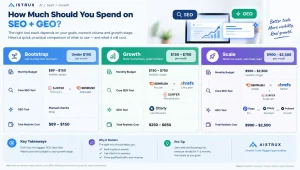
Keep in mind every vendor listed here updates pricing throughout the year — treat this table as a shopping starting point, not a locked quote, and always confirm current numbers on the vendor’s own pricing page before subscribing.
How to Choose Between Competing Tools at the Same Tier
Every tier above lists more than one option, and the right pick usually comes down to one deciding factor rather than a long feature checklist.
Semrush vs. Ahrefs at the Growth tier: choose Semrush if you want one platform covering SEO, basic content guidance, and PPC research together — it’s the more general-purpose choice. Choose Ahrefs if backlink analysis and competitor gap research are your primary use case; <cite index=”61-1″>its backlink and keyword history data are widely considered stronger than Semrush’s equivalent features</cite>, even though its entry price sits slightly higher.
Otterly vs. Peec at the Growth-to-Scale transition: <cite index=”45-1″>Otterly’s Standard plan and Peec’s Pro plan land at similar price points, but Peec offers unlimited user seats on every plan while Otterly’s seat allowances vary by tier</cite> — if more than one team member needs direct access to citation dashboards, that seat structure alone can decide it. Peec is also EU-hosted, which occasionally matters for data-residency preferences; Otterly is the more established choice for U.S.-based teams prioritizing simplicity.
Surfer vs. skipping content optimization tools entirely: if your team already has a strong internal editorial process — someone who understands search intent and structures content well without software prompting — a dedicated content optimization tool is a nice-to-have, not a must-have, at any tier. The clearest signal you need one: your content ranks inconsistently despite reasonable effort, and you can’t tell why.
What Changes as You Scale From One Tier to the Next

The stack described above isn’t meant to be rebuilt from scratch every time your budget grows — most of it upgrades in place.
Moving from Bootstrap to Growth typically means upgrading your existing SEO tool’s plan tier (rather than switching vendors) and adding your first GEO subscription. Moving from Growth to Scale usually means adding a content optimization layer like Surfer on top of your existing SEO platform, upgrading your GEO tool’s engine coverage, and bringing in a freelancer or fractional specialist to handle the production volume your tools alone can’t.
The exception worth planning for: if you started on a budget GEO tool that later can’t support the engine coverage or team size you need, migrating to a new vendor does mean losing your historical citation tracking data. This is the one real switching cost in this stack, and it’s worth weighing against simply upgrading your current vendor’s tier instead — even at a higher monthly price, keeping continuous citation history has real long-term value, similar to how switching domains resets years of accumulated SEO authority.
Do I need both an SEO tool and a separate GEO tool, or is there one platform that does both? A few platforms are starting to bundle both — Semrush now includes an AI Visibility toolkit alongside its core SEO product, for example. For most small businesses, though, running a dedicated SEO tool alongside a focused GEO tool still gives more accurate, specialized data than an all-in-one bundle at the same price point.
Is it worth switching from Surfer to Semrush’s content tools to save money? Only if you’re already paying for Semrush’s broader platform and its content optimization feature covers what you need — <cite index=”61-1″>Semrush’s content tools are generally considered less specialized than dedicated options like Surfer</cite>, so the savings come with a real feature trade-off, not just a lower bill.
What’s the biggest tool-stack mistake businesses make when their budget grows? Adding tools instead of upgrading them. It’s usually cheaper and more effective to move your existing GEO tool from its entry tier to its growth tier than to add a second, unrelated platform — the historical citation data stays intact, and you avoid paying for overlapping features across two vendors.
Should I pay annually or monthly for these tools? Most vendors in this stack discount annual billing meaningfully — <cite index=”56-1″>Surfer’s annual plans save roughly 17–20% compared to monthly billing</cite>, and similar discounts are standard across Semrush, Ahrefs, and most GEO platforms. Annual billing makes sense once you’re confident in a tool after a full monthly billing cycle or two; paying monthly first lets you validate fit before committing a year of budget.
Can I run this stack solo, or do I need a content person? The Bootstrap and Growth tiers are built to be run solo, with the tools handling research and optimization guidance while you or a part-time contractor handle the actual writing. The Scale tier assumes at least fractional specialist support, since the tools alone can’t produce the volume of original content and outreach that tier’s ROI depends on.
This guide is a companion piece to Aistrux’s SEO or GEO First? A Founder’s Budget-Based Decision Guide for 2026. For a deeper technical comparison of AI visibility platforms specifically, see our AI Visibility and Rank Tracking Tools 2026 review.