
There’s a specific kind of soreness that shows up two days after a hard training block — not in your legs, but in your decision-making. You know you should recover better. You’ve read the articles about lymphatic drainage and DOMS. You’ve probably even added a pair of compression boots to a cart at some point and closed the tab, unsure if you were buying a real recovery tool or a $700 placebo with good marketing.
That hesitation is fair. Recovery boots , pneumatic compression devices that squeeze your legs in timed, sequential pulses have gone from niche NBA locker-room equipment to a genuine category inside the home recovery market. But “popular” and “worth it” aren’t the same thing, and in 2026 the market is crowded enough that picking the wrong pair means picking up a very expensive pair of inflatable pants that live in a closet by March.
This guide exists to answer one question honestly: which recovery boots are actually worth owning in 2026, for whom, and why not because they’re new, but because we tested whether they change how your legs, and your week, actually feel.
We’re going to walk through the mechanism (so you understand what you’re paying for), the real comparison between the major players, and — the part most buying guides skip — how to actually build these into a weekly recovery protocol so they don’t end up as an expensive doorstop.
Table of Contents
- What Recovery Boots Actually Do (And Where the Science Holds Up)
- The 2026 Recovery Boots Landscape: Who’s Actually Building What
- How to Choose the Right Pair for Your Body, Sport, and Budget
- Building a Real Recovery Protocol Around Them
- The AI Layer: What’s Genuinely New in 2026
- FAQ, Decision Framework & Final Verdict
What Recovery Boots Actually Do, And Where the Science Holds Up
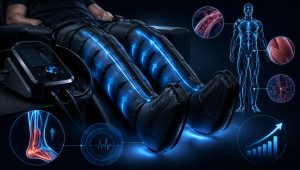
Recovery boots use pneumatic compression the same underlying technology hospitals have used for decades to prevent blood clots in immobile patients, adapted for athletic recovery. Chambers inside the boots inflate and deflate in a sequential pattern, starting at the foot and moving upward, mimicking the muscle pump your calves and legs normally provide when you walk or run.
The physiological argument is straightforward: intense training causes micro-trauma in muscle fibers, plasma and metabolic byproducts (like lactate) pool in the tissue, and swelling even at a microscopic level slows the clearance of that waste. Sequential compression accelerates venous return and lymphatic flow, in theory clearing that pooled fluid faster and reducing the sensation of DOMS (delayed onset muscle soreness).
Here’s where we separate marketing from evidence, because that distinction matters if you’re spending real money:
- What’s well-supported: Pneumatic compression reliably reduces perceived soreness and improves perceived recovery in the 24–72 hour window after intense exercise. Multiple studies on intermittent pneumatic compression (IPC) show measurable reductions in subjective muscle soreness scores.
- What’s mixed: The effect on actual performance recovery — things like vertical jump height, sprint times, or force output in the following session — is smaller and less consistent than marketing copy implies. Some studies show modest benefit; others show no meaningful difference versus passive rest.
- What’s overstated: Claims that compression boots “flush lactic acid” in the way marketing often implies. Lactate clearance happens through metabolic pathways, not primarily through fluid displacement, and most lactate clears within an hour regardless of intervention.
The honest takeaway: recovery boots are a subjective recovery and comfort tool with real physiological backing for soreness reduction, not a magic performance multiplier. That’s not a knock — reducing soreness is genuinely valuable for training consistency, sleep quality, and adherence. It’s just not the same claim as “makes you recover 40% faster,” which is the kind of language you’ll see on product pages that don’t survive contact with peer review.
Where recovery boots fit in the broader recovery stack
Recovery boots work best as one layer in a stack, not a standalone solution. The layers, in order of evidence strength:
- Sleep quality and duration (the single highest-leverage recovery input)
- Nutrition and hydration timing
- Active recovery (light movement, walking, easy zone 2 work)
- Pneumatic compression and other passive modalities (recovery boots, percussion, cold exposure)
- Passive rest days
If someone is sleeping five hours a night and skipping meals, no amount of compression boot use will offset that. This matters for how you evaluate the category: recovery boots amplify a good recovery foundation — they don’t replace one.
The 2026 Recovery Boots Landscape: Who’s Actually Building What
The category has consolidated around a handful of serious players, plus a wave of budget alternatives that copy the mechanical design at a fraction of the cost. Here’s the real landscape.
The premium tier: Therabody RecoveryAir and Normatec
Normatec , now under Hyperice ownership, essentially created the consumer version of this category and remains the reference point every competitor is measured against. The current generation emphasizes app-controlled pressure zones, adjustable overlapping compression patterns, and a portfolio that spans full-leg, hip, and arm attachments.
Therabody’s RecoveryAir line is the most direct competitor, differentiated mainly by its “Prime” and “Jetboots” lines , the latter aimed specifically at portability, with battery-powered, wireless boots designed for travel and post-race use at events rather than only at home.
Between these two, the practical differences that matter to a buyer are:
- Pressure range and zone control, how granular the app lets you get with targeting specific segments of the leg
- Portability, battery-powered wireless units versus plug-in models tethered to a control unit
- App ecosystem, whether the app is a genuine recovery hub (session logging, guided programs) or just a Bluetooth remote
The mid-tier and budget alternatives
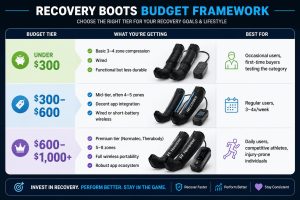
A second tier of brands has emerged building mechanically similar products same sequential pneumatic compression concept at 40–60% of the premium price point. The tradeoffs are generally:
- Wider inflation increments (less precise pressure control)
- Shorter warranty periods and less rigorous manufacturing QA
- Fewer pressure zones (often 3–4 versus 5–8 on premium units)
- Louder pumps and shorter compressor lifespan under daily use
For a casual user doing two or three sessions a week, a well-reviewed mid-tier pair is often genuinely sufficient. For someone in daily heavy training a competitive endurance athlete, a CrossFit competitor, someone rehabbing from injury — the precision and durability of the premium tier tends to justify the price difference over an 18–24 month ownership period.
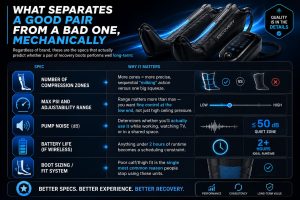
What separates a good pair from a bad one, mechanically
Regardless of brand, these are the specs that actually predict whether a pair of recovery boots performs well long-term:
How to Choose the Right Pair for Your Body, Sport, and Budget
This is where most buying guides get generic. The right recovery boots depend heavily on who’s using them and why so here’s a decision framework broken down by real-world profile rather than a single “best overall” pick that ignores context.
If you’re an endurance athlete, running, cycling, triathlon
Prioritize full-leg coverage with hip attachment compatibility and higher zone count. Endurance training creates diffuse fatigue across the whole kinetic chain calves, quads, hamstrings, hips so a boot that only compresses the lower leg misses most of the fatigued tissue. Portability also matters more here, since race-day and travel use cases are common.
If you’re a strength, power athlete (lifting, CrossFit, sprinting)
Prioritize higher max PSI and precise segment control over portability. Strength training tends to create more localized, intense soreness (often quads and glutes after heavy squat work), so the ability to dial in pressure on specific zones matters more than whether the unit is battery-powered.
If you’re recovering from injury or surgery (with clinical guidance)
This is the one profile where we’d say: talk to a physical therapist or physician before buying anything. Some injury and post-surgical presentations (certain vascular conditions, active DVT risk, specific post-op protocols) are contraindications for pneumatic compression, and a generic buying guide can’t substitute for that assessment.
If you’re a desk-based professional or general wellness user
Prioritize noise level, ease of use, and app simplicity over performance specs. If the goal is end-of-day leg fatigue and circulation rather than athletic performance recovery, a mid-tier unit with good ergonomics will likely get used more consistently than a premium unit that feels like overkill for the use case — and the best recovery tool is the one you actually use.
Budget framework
Building a Real Recovery Protocol Around Them
Owning recovery boots and actually benefiting from them are two different outcomes, and the gap between them is protocol. Here’s how to build one that sticks.
Session timing and duration
Most evidence-backed protocols use 15–30 minute sessions, ideally within the 1–4 hour window post-exercise, though evening use (even hours later) still shows subjective benefit for next-day soreness. Pressure typically ranges from 40–80 mmHg depending on tolerance and zone — starting lower and increasing gradually is the standard approach for new users.
A sample weekly structure for a hybrid athlete
- Hard training days (legs): 20-minute session within 2 hours post-workout, moderate-to-high pressure
- Easy/active recovery days: Optional 15-minute session, lower pressure, paired with light stretching
- Rest days: Skip or use a short session purely for circulation and comfort
- Travel/race days: Short 10–15 minute session pre- and post-travel to counter prolonged sitting
Stacking with other recovery inputs
The highest-value stacking pattern we’ve seen work in practice: compression boots after a short cold exposure or contrast shower, before the final wind-down of the evening, paired with a consistent sleep window. The sequencing matters less than the consistency irregular use produces irregular results, which is the single biggest reason people conclude “these don’t work” when the real issue was a three-times-a-month usage pattern.
The operational reality: what actually gets people to keep using them
In practice, adherence comes down to friction removal: boots stored somewhere visible (not in a closet), a charged battery (for wireless units) always ready, and a fixed time slot — end-of-day TV time, post-shower routine — rather than an “I’ll use it when I remember” approach. This is the unglamorous part of the category that most reviews skip, but it’s the actual difference between a tool that gets used for years and one that gets sold on a marketplace six months in.
The AI Layer: What’s Genuinely New in 2026

The most meaningful shift in this category over the past two years isn’t the compression mechanism itself that technology has been largely mature for a decade. It’s the software layer wrapping around it.
Several manufacturers now offer adaptive compression algorithms that adjust pressure and timing based on data pulled from connected wearables sleep quality from a ring or watch, training load from a connected app, even subjective soreness input logged by the user. Instead of a fixed 20-minute program, the system recommends (or auto-adjusts) session length and pressure based on how recovered your body’s data says you actually are.
This is worth taking seriously, but also worth evaluating skeptically. The mechanical benefit of compression doesn’t change because an algorithm is choosing the pressure curve the value-add is convenience and personalization, not a new physiological effect. Where it does add genuine value: reducing the guesswork for new users, and creating a feedback loop (session logging plus recovery tracking) that improves adherence, which circles back to the biggest lever in this category consistency.
We cover this in more depth in our dedicated piece on AI-connected recovery boots and biometric integration, including which integrations are genuinely useful versus which are software dressing on a decade-old mechanism.
FAQ, Decision Framework & Final Verdict
Do recovery boots actually work, or is it placebo? The soreness-reduction effect is reasonably well-supported in research; the performance-enhancement claims are weaker and inconsistent. Expect meaningful subjective benefit, modest-to-unclear objective performance benefit.
How often should I use recovery boots? Most protocols land on 3–5 sessions per week for regular training athletes, 15–30 minutes per session, with more frequent short sessions outperforming infrequent long ones for adherence.
Are expensive recovery boots worth it over budget options? For daily heavy use, yes — durability and zone precision compound in value over 18+ months of ownership. For occasional/casual use, a mid-tier option is often sufficient.
Can recovery boots replace stretching or physical therapy? No. They’re a complementary passive-recovery modality, not a substitute for mobility work, strength training, or clinical rehab guidance.
Is there a medical reason not to use recovery boots? Yes — certain vascular conditions, active blood clot risk, or specific post-surgical situations are contraindications. Consult a physician if you have any relevant history before starting use.
Final verdict
If you train hard enough, often enough, that soreness is genuinely limiting your training consistency or sleep quality, recovery boots are a defensible, evidence-informed investment — provided you pick a pair matched to your actual use case rather than the most heavily marketed option, and provided you build the consistent habit that makes the physiological benefit compound over time. If you train casually two or three times a month, the money is better spent elsewhere in your recovery stack.
For a deeper look at the mechanism itself, see how pneumatic compression recovery boots actually work. For a full head-to-head breakdown of the major brands, see our 2026 recovery boots comparison. And for a step-by-step weekly protocol, see how to build a recovery boots protocol into your routine.